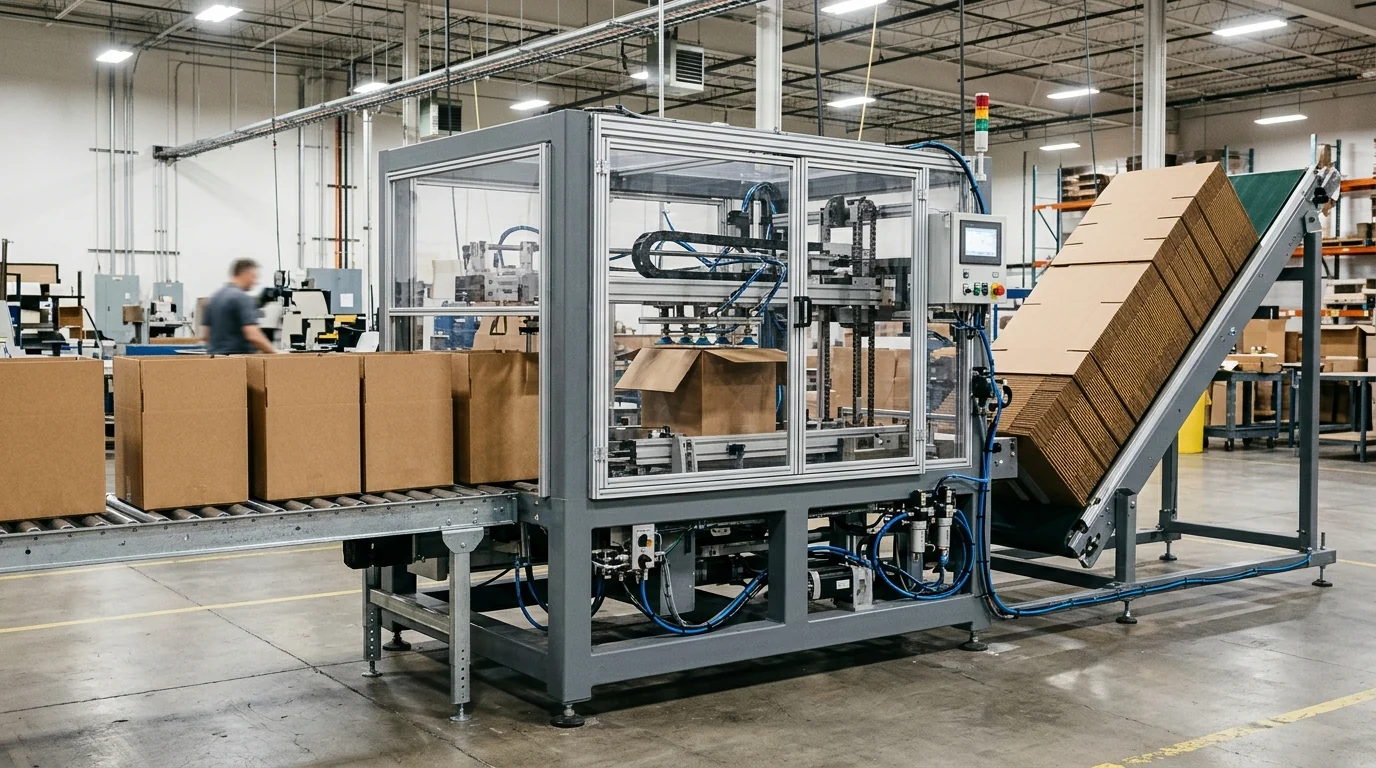
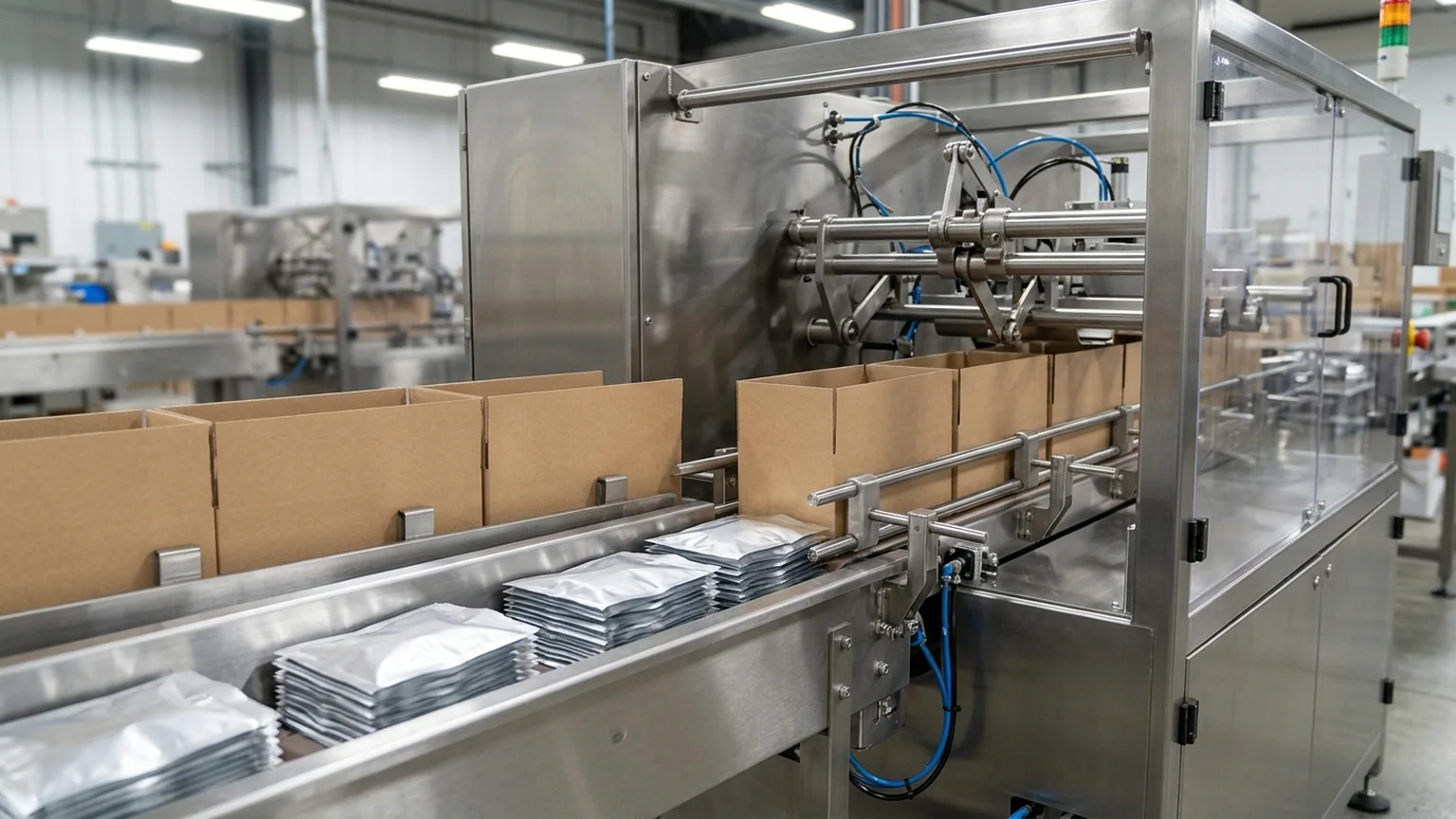
A reactive PUR hot melt adhesive seals folding-carton flaps on two distinct clocks: seconds of physical cooling under belt compression to hold flap springback, followed by multi-day chemical crosslinking with moisture into an unmeltable thermoset film. Across packaging machinery lines running varnished, metallised, or plastic-film cartons, the mating flap must contact the hot adhesive within its effective open time, and the compression section must hold the seam until green strength develops. Immediately after cooling, a reactive polyurethane bond is no stronger than a conventional hot-melt joint; full thermoset resistance develops over 2 to 7 days depending on adhesive grade, compressed film thickness, substrate, and ambient humidity.
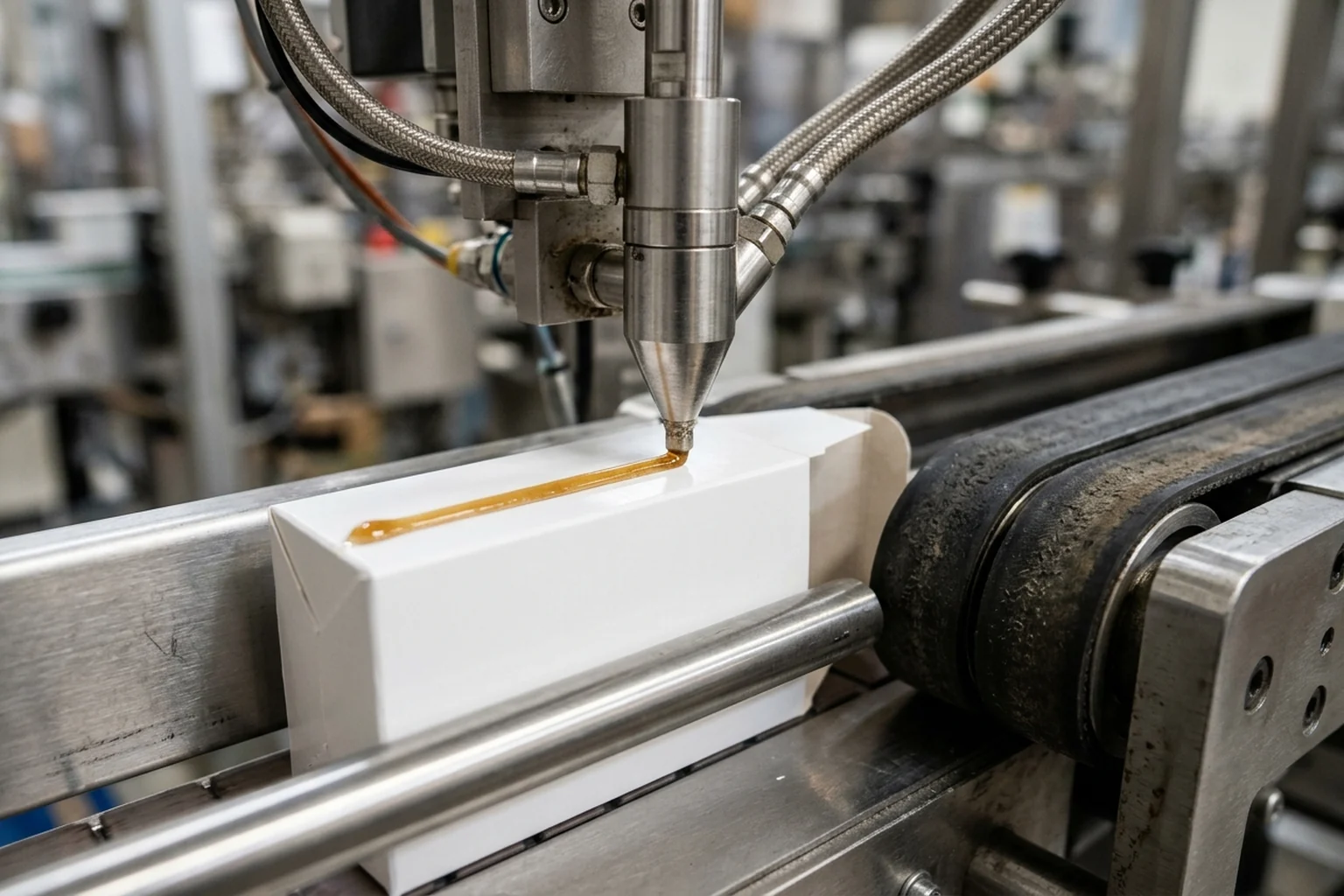
PUR vs EVA Packaging Hot Melt: Cooling Set vs Moisture Cure
Conventional EVA and thermoplastic packaging hot melts complete their entire bond by hot tack and cooling to ambient temperature, whereas reactive polyurethane (PUR) hot melt combines physical cooling set with irreversible moisture crosslinking. In L.D. Davis’s mechanism comparison of EVA and PUR hot melts, EVA grades run in open dispensing tanks and reach final strength once cooled, while reactive PUR stays sealed in its package until use, melts inside an air-isolated closed system, forms an initial handling bond within seconds, and crosslinks once exposed to atmospheric moisture.
Baumer hhs explains why substrate finish drives the chemistry switch in folding-carton converting. Standard thermoplastic hot melts build strength by mechanically anchoring liquefied polymer between rough paper fibers, a structure absent on smooth metallised board, heavy varnishes, and plastic films. Reactive polyurethane wets prepared surfaces at or above 36 mN/m and chemically attacks hydroxyl (-OH) groups naturally present in paper and paperboard, or pretreated sites above 38 mN/m on clear-box films.
| Selection parameter | EVA and thermoplastic packaging hot melt | Reactive polyurethane (PUR) hot melt |
|---|---|---|
| Dispensing enclosure | Runs in open hot-melt tanks exposed to shop air (L.D. Davis) | Kept sealed until use; processed in closed systems, or requires dry-nitrogen / dry-air blanketing in conventional tanks (Baumer hhs; L.D. Davis) |
| Adhesion mechanism on carton flaps | Liquefied polymer anchors mechanically between rough paper fibers (Baumer hhs) | Physical wetting at surface energy of at least 36 mN/m plus chemical reaction of isocyanate (-NCO) groups with hydroxyl (-OH) groups and water (OSHA; Baumer hhs) |
| Initial hold leaving compression | Bond completes as melt cools through green-tack zone: Fast under 2 seconds, Medium 2 to 4 seconds, Slow above 4 seconds (H.B. Fuller) | Physical cooling delivers initial handling strength, yet the freshly cooled joint is initially no stronger than a conventional hot melt (Baumer hhs; Technopur CB 2005-21) |
| Final bond completion | Reached upon cooling to ambient temperature (L.D. Davis) | Reached after moisture crosslinking: 2 to 3 days for closed-system grades (Baumer hhs), 2 to 5 days for Purmelt CB 2007-21, and 3 to 7 days for Technopur CB 2005-21 at ambient temperature of at least 20°C |
| Thermal behavior after cure | Thermoplastic polymer re-softens under heat; a grade with a 221°F softening point may hold service heat resistance only to 150–160°F (H.B. Fuller) | Crosslinked prepolymer forms a thermosetting film that cannot be remelted (Baumer hhs) |
H.B. Fuller defines packaging adhesive heat resistance as maintaining a bond above 120°F and cold resistance as maintaining a bond below 0°F, warning that a thermoplastic hot melt’s listed softening point overstates its structural heat limit under flap tension. When sealed cartons face elevated shipping temperatures, cold-chain storage, or slick non-porous coatings where mechanical fiber anchoring fails, reactive PUR provides thermoset permanence after curing finishes.
How Do Open Time and Compression Dwell Stop Flap Pop-Open?
Keeping glued carton flaps shut requires satisfying two simultaneous conveyor timing inequalities: transfer time from glue nozzle to flap contact must stay shorter than effective open time, and dwell inside the compression belts must equal or exceed green-strength buildup time. H.B. Fuller defines open time as the post-application window while adhesive remains molten enough to wet out and bond, and set speed as the interval after application and compression until the joint solidifies enough to produce destructive fiber tear. For hard-to-glue folding cartons, Baumer hhs defines open time specifically for a hot adhesive layer of defined thickness.
On a continuous cartoner or folder-gluer running at conveyor speed v, two physical lengths along the frame govern whether flaps stay closed:
- Transfer window before flap closure: ttransfer = Ltransfer / v < topen, where Ltransfer is the travel distance between the glue nozzle and the entry of the compression belt.
- Compression hold before release: tdwell = Lcompression / v ≥ tgreen, where Lcompression is the active clamping length of the compression belts and tgreen is the cooling interval required to resist board springback.
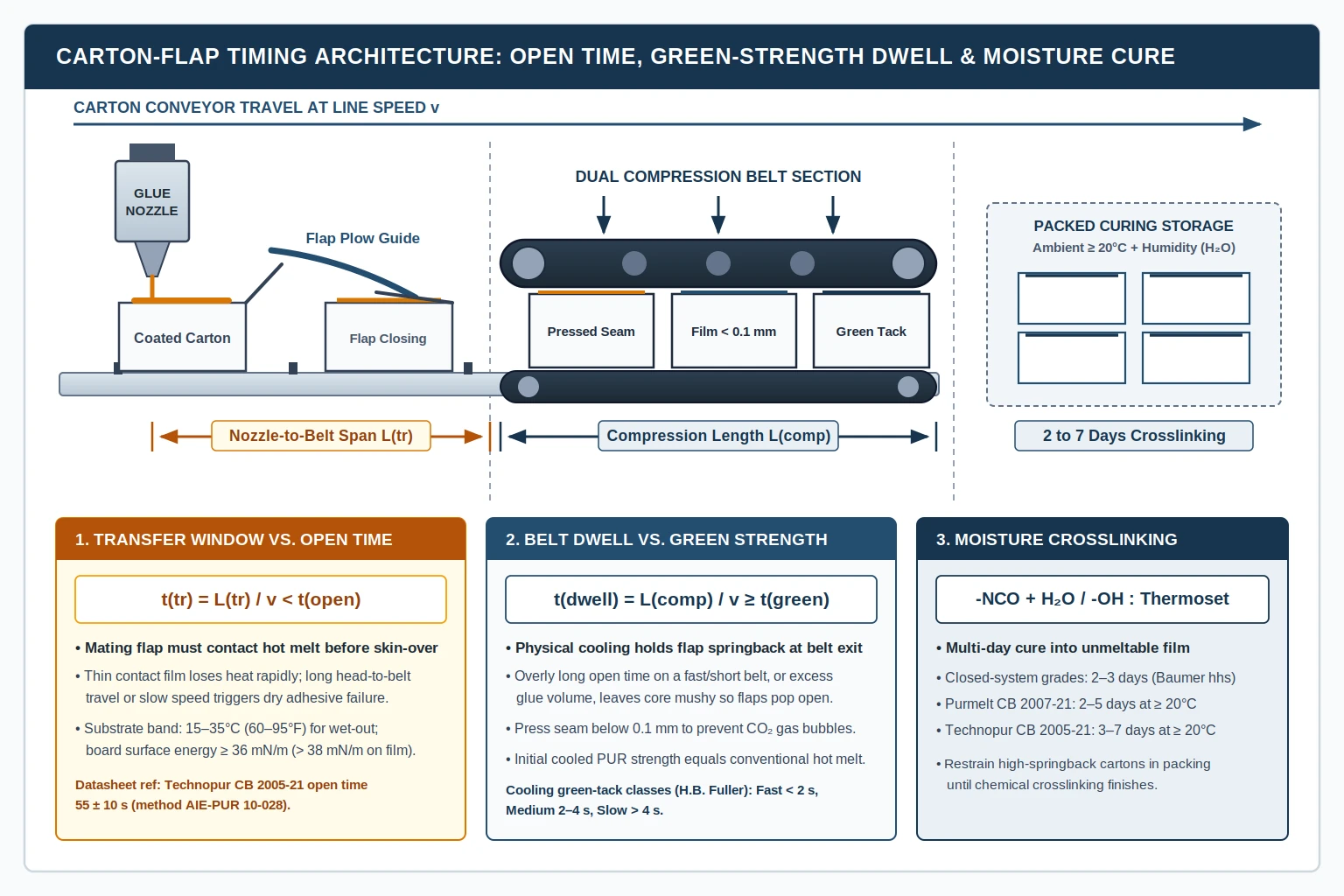
Published open times and cooling-set bands show why neither inequality can be guessed from a generic rule. On Van Asperen’s technical sheet for Technopur CB 2005-21, open time is 55 ± 10 s by test method AIE-PUR 10-028, paired with a melt viscosity of 7.500 + 1.500 mPas at 130°C (Brookfield Thermosel, spindle 27). On H.B. Fuller’s cooling-set packaging scale, green tack (the state in which a destructive bond has not yet formed, yet cooling adhesive holds the box shut) falls into Fast (less than 2 seconds), Medium (2 to 4 seconds), and Slow (greater than 4 seconds).
Baumer hhs and H.B. Fuller document three recurring timing mismatches when pairing open time, bead thickness, and conveyor geometry across horizontal vs vertical cartoner flap handoff stations:
- If open time is very long and machine speed is high (or the compression belt is short), the adhesive does not shed enough heat inside the belts to build green strength, and freshly glued cartons pop open on the delivery belt.
- If operators apply extra adhesive hoping to strengthen a popping flap, the thicker molten mass retains heat longer, slows set time, causes squeeze-out, and pushes flaps to spring open right out of compression.
- If PUR is applied as a very thin film, its temperature drops rapidly and shortens the effective pressing window; when slow line speeds or long nozzle-to-belt spans delay compression entry, the cooled film fails to wet the mating flap.
Why Do Coated, Varnished, and Film Carton Flaps Spring Open?
Coated, UV-varnished, metallised, and plastic-film carton flaps spring open when low surface energy blocks wetting, chilled board flash-cools the bead, or stiff board resilience overpowers an uncured seam. Baumer hhs specifies a minimum substrate surface energy of 36 mN/m for good wettability and bonding on folding cartons. Plastic clear-box films lack natural hydroxyl groups entirely; both Technopur CB 2005-21 (covering A-PET, G-PET, and pretreated PP films) and Purmelt CB 2007-21 require film pretreatment above 38 mN/m (38 dyn) verified through industrial trials before production.
Board temperature and blank conditioning upstream also shift the bonding window. H.B. Fuller states that substrate temperatures above 15°C (60°F) and below 35°C (95°F) give optimal results; cartons delivered from cold storage chill the hot melt on contact, sharpening set speed and preventing surface wet-out. Reviewing crease stiffness and blank flatness during paperboard blank separation and infeed checks prevents uncreased flap memory from overloading the cooling joint at belt exit.
| Seam failure observation | Failure mode classification | Verified physical causes | Corrective line or material check |
|---|---|---|---|
| Glue strip releases cleanly from one smooth coated or film flap with bare surface opposite | Adhesive failure (lack of wetting or penetration) | Open time expired or thin film skinned over before compression entry; board colder than 15°C (60°F); surface energy below 36 mN/m on board or 38 mN/m (38 dyn) on plastic film (H.B. Fuller; Baumer hhs; Technopur CB 2005-21; Purmelt CB 2007-21) | Shorten nozzle-to-belt transfer time, switch from contact thin-film smear to heat-retaining bead over long spans, verify corona/plasma dyne level, and condition blanks within 15–35°C (60–95°F) |
| Adhesive splits within itself, leaving stringy or gummy residue on both flaps | Cohesive failure (core still mushy at release) | Excessive adhesive volume slowing heat loss; application temperature set too high; compression time or belt pressure too low; flap movement during mushy green-tack phase; adhesive open time too long for high speed or short belt (H.B. Fuller; Baumer hhs) | Meter down bead volume rather than adding glue, extend compression dwell or lower line speed to satisfy tdwell ≥ tgreen, and steady plow/belt alignment |
| Seam holds at belt exit, then pops open hours later in trays or pallet loads | Springback during multi-day moisture cure | Initial cooled PUR joint is no stronger than conventional hot melt while high-resilience board pulls against the seam during the 2 to 7 day crosslinking window (Baumer hhs; Technopur CB 2005-21) | Keep high-resilience cartons packed correctly during curing and maintain storage ambient at or above 20°C |
| Visible gas bubbles or foaming along clear-box or thin folding-carton glue seam | Carbon dioxide bubble entrapment | Reaction between isocyanate groups and water releases carbon dioxide molecules inside thick adhesive beads (Baumer hhs; Technopur CB 2005-21) | Apply minimal adhesive quantity and increase roller or belt pressure to compress the film below 0.1 millimetres |
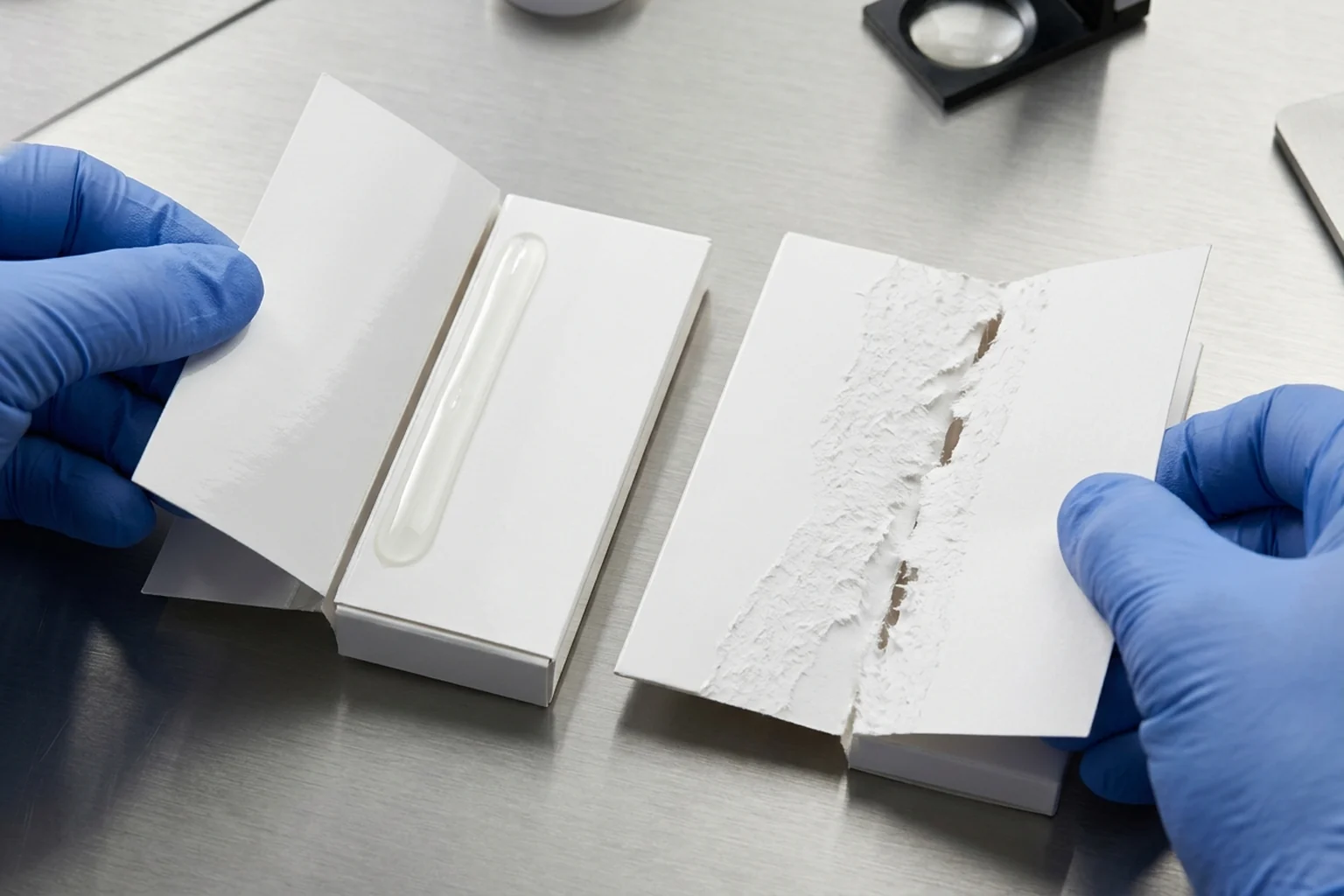
When destructive peel testing tears paperboard fibers across the glue line, H.B. Fuller classifies the result as fiber tear, demonstrating that substrate penetration and compression succeeded and the adhesive is no longer the weakest link in the joint.
How Long Does Reactive PUR Hot Melt Take to Crosslink?
Reactive PUR carton seams require 2 to 7 days at an ambient temperature of at least 20°C to reach final crosslinked strength, depending on the specific prepolymer formulation, compressed film thickness, and available moisture. Because physical cooling delivers initial handling strength long before isocyanate-water reactions finish, production teams must separate immediate packout handling from final QA thermal or peel testing.
| Published reference | Viscosity and test condition | Open time on sheet | Cure time to final strength | Stated curing conditions |
|---|---|---|---|---|
| Technopur CB 2005-21 (Van Asperen) | 7.500 + 1.500 mPas at 130°C (Brookfield Thermosel, spindle 27) | 55 ± 10 s (method AIE-PUR 10-028) | 3–7 days | Ambient temperature at least 20°C; depends on humidity, adhesive thickness, and film quality |
| Purmelt CB 2007-21 (Van Asperen) | 8000 ± 2000 mPas at 130°C (Brookfield RVT, spindle 27, 30 rpm) | Verify per trial | 2–5 days | Ambient temperature at least 20°C; high handling strength present after physical setting |
| Baumer hhs folding-carton PUR overview | Grade-dependent for closed application systems | Defined-thickness layer window | 2 to 3 days | High-resilience cartons can pop open if they were not packed correctly before crosslinking finishes |
| L.D. Davis EVA vs PUR comparison (general assembly/bookbinding note) | Closed-system reactive PUR | Initial bond within seconds | Most cure within eight hours; full crosslinking by two days | Cure rate varies between humid and arid atmospheric conditions |
Across both folding-carton datasheets (Technopur CB 2005-21 and Purmelt CB 2007-21), warehouse or staging floors dropping below 20°C stall moisture curing. On non-porous plastic clear boxes (A-PET, G-PET, or pretreated PP) or heavily laminated board where moisture diffuses primarily through seam edges, pressing the bead into a thin, even film below 0.1 millimetres prevents carbon dioxide bubbling while keeping cure progression uniform.
Closed-System Melters, Moisture Skinning, and Nozzle Care
Reactive PUR hot melt must remain isolated inside its sealed container until loading into a closed melt-on-demand system because ambient humidity forms an unmeltable thermosetting skin over exposed melt within a few hours at most. Baumer hhs notes a second thermal degradation clock alongside moisture skinning: even when held at a constant temperature, the viscosity of some polyurethane hot melts can double within a few hours.
Running reactive PUR in a conventional open hot-melt tank requires blanketing residual adhesive with dry nitrogen or dry air to block atmospheric moisture, while still leaving operators exposed to tank vapors and dermal contact risks during manual loading or skimming. By contrast, Baumer hhs notes that a closed bag melter isolates the molten prepolymer from shop air, eliminating the need for dry-nitrogen or dry-air gas blanketing.
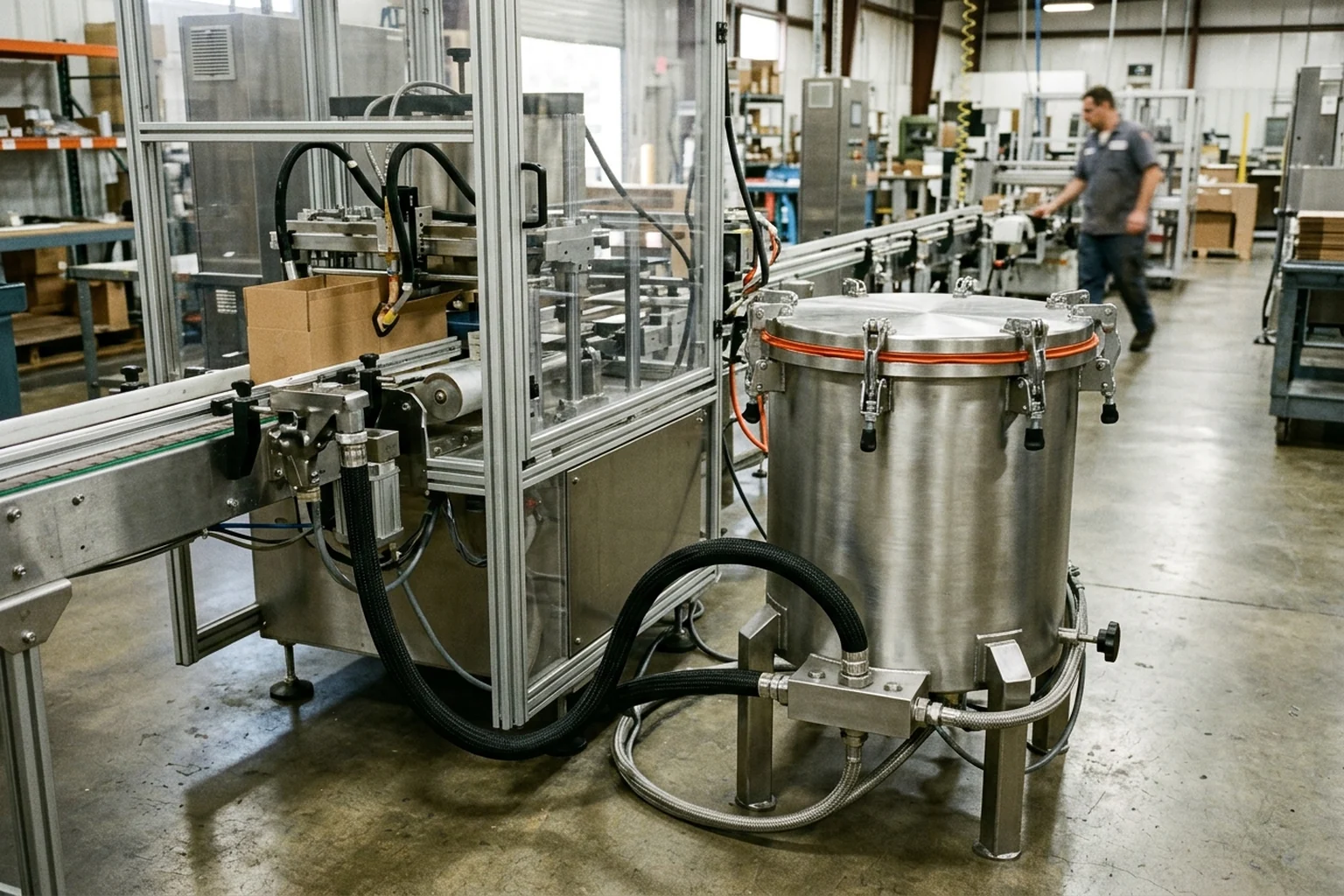
Graduated temperature zones from premelter to applicator keep bulk adhesive cooler until the moment of dispensing. Technopur CB 2005-21 specifies premelting at 100–130°C, heated hose transport at 120–150°C, and nozzle application at 140–160°C. Because reducing hot-melt temperature by 50°F generally doubles viscosity according to H.B. Fuller, cold spots along hoses or manifolds restrict flow and alter bead volume, whereas holding the entire reservoir at nozzle temperature accelerates viscosity drift.
Documenting closed-lid clamp seals, zone temperature verification, and shift-end nozzle protection inside a packaging machine maintenance checklist prevents cured polyurethane skins from blocking orifices at startup. Multi-day line shutdowns, heated-hose inspections, and seal replacements belong on a recurring preventive maintenance schedule template so adhesive never sits stagnant at elevated heat across idle shifts.
What MDI Isocyanate Exposure Controls Apply at the Glue Head?
US packaging plants heating reactive PUR hot melt must keep airborne Methylene bisphenyl isocyanate (MDI, CAS 101-68-8) strictly below the federal OSHA ceiling limit of 0.02 ppm (0.2 mg/m³) under 29 CFR 1910.1000, prioritizing closed melting and local exhaust engineering controls ahead of respirators. Under 29 CFR 1910.1000(a)(1) and Table Z-1 footnote 1, a (C) ceiling designation determined from breathing-zone air samples shall at no time be exceeded; only when instantaneous monitoring is infeasible is the ceiling assessed as a 15-minute time-weighted average that must never be exceeded during the working day.
Baumer hhs reports that polyester-urethane prepolymers used in folding-carton gluing carry 1–3% MDI (diphenylmethane-4,4'-diisocyanate) and small quantities of TDI (2,4-toluene diisocyanate) under EC Directive 91/155/EEC hazard disclosures. Baumer hhs places the critical range where isocyanates leave the melted adhesive at roughly 140°C, and some textbooks recommend a processing temperature below 130°C, while Technopur CB 2005-21 lists nozzle application at 140–160°C on its technical sheet. Even with a closed premelter and hose, the heated nozzle discharge remains open to air, making point-of-application vapor capture essential.
| Jurisdiction or agency | Published limit | Averaging or ceiling rule | Control note |
|---|---|---|---|
| US Federal OSHA (29 CFR 1910.1000 Table Z-1) | (C) 0.02 ppm / (C) 0.2 mg/m³ |
Ceiling limit; never exceeded (15-minute TWA assessment only if instantaneous monitoring is infeasible) | Feasible administrative or engineering controls must be implemented first under 1910.1000(e); any required respirator use must comply with 29 CFR 1910.134 |
| Cal/OSHA (OSHA Annotated Table Z-1, as of 11/12/2021) | 0.005 ppm |
State permissible exposure limit listed on OSHA Annotated Table Z-1 | Cal/OSHA PEL on the MDI row, lower than the federal ceiling of (C) 0.02 ppm |
| NIOSH (OSHA Annotated Table Z-1, as of 11/15/2021) | 0.05 mg/m³ TWA; (C) 0.2 mg/m³ [10-min] |
Workshift TWA paired with a 10-minute ceiling | NIOSH REL on the same MDI row of OSHA Annotated Table Z-1 |
German Section 18 GefStoffV benchmark (cited by Baumer hhs, non-US reference) |
0.05 mg/m³ constant upper limit for isocyanates |
Continuous upper limit in German workplace law | For an open PU gluing unit, Baumer hhs cites a hood-sealed extractor of at least 300 m³/h and at least 1,000 pascal vacuum |
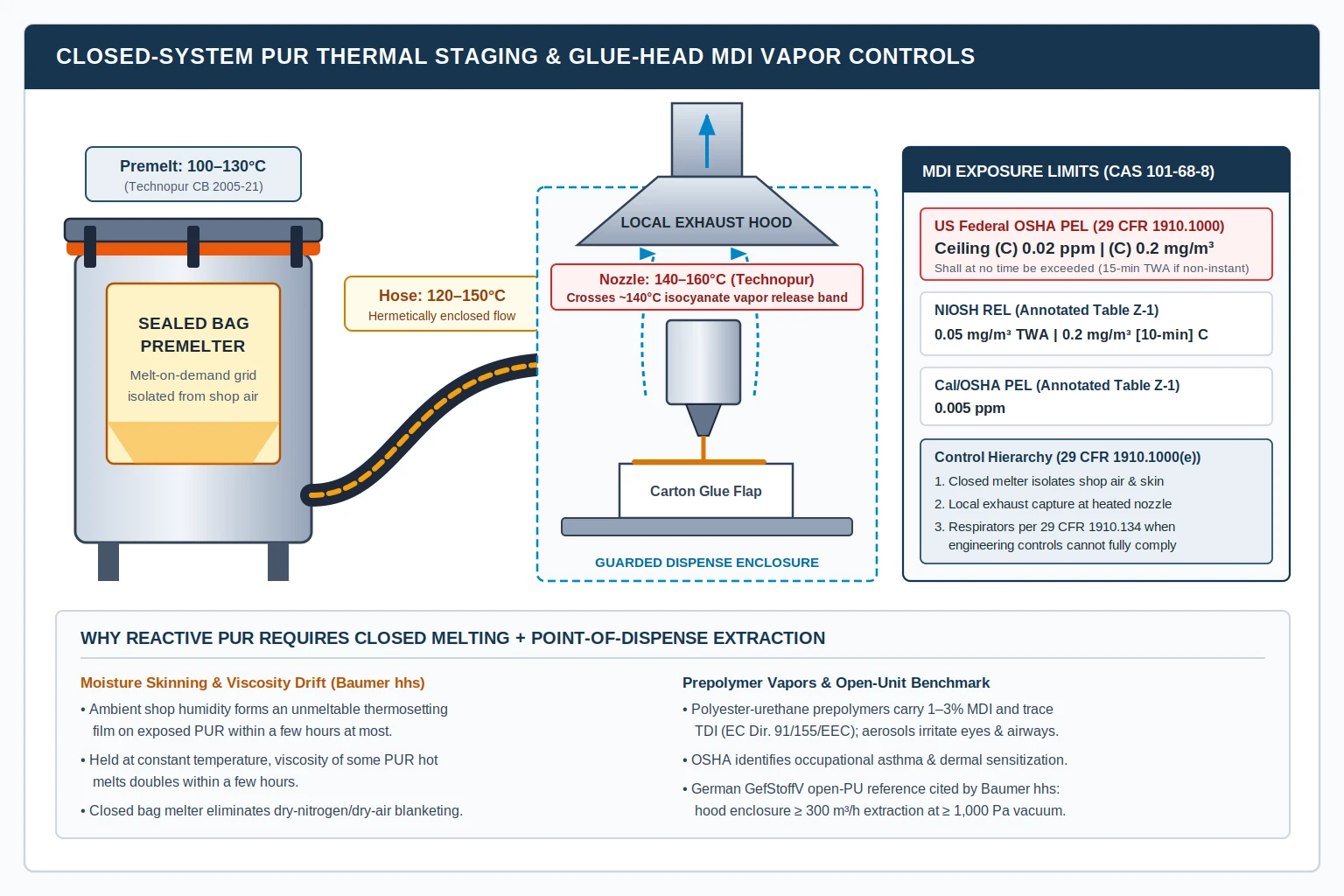
According to OSHA Safety and Health Topics: Isocyanates, exposure during adhesive application, packaging operations, or thermal degradation of polyurethanes can irritate the eyes, nose, throat, skin, and airway mucous membranes, causing chest tightness, difficult breathing, and occupational asthma. Baumer hhs likewise warns that an open adhesive tank makes direct skin contact with molten adhesive more likely and that the body can absorb isocyanates through the skin, while a closed adhesive system keeps those vapours out of the workplace.
Food-Packaging Rules (21 CFR 175.105) and Withdrawn ASTM Methods
Qualifying a reactive PUR hot melt for food folding cartons in the United States requires satisfying both compositional and physical seam-integrity rules under 21 CFR 175.105, while relying on adhesive datasheets and line trials rather than withdrawn ASTM hot-melt standards. Under 21 CFR 175.105(c), polyurethane resins produced by reacting diisocyanates with one or more listed polyols or polyesters appear among permitted optional substances, and individual grades state product-level compositional compliance on their technical sheets (as Technopur CB 2005-21 documents for FDA § 175.105).
Compositional listing alone does not clear a carton line for food production. Under 21 CFR 175.105, the finished adhesive container label must carry the statement "food-packaging adhesive", and unless a functional barrier separates the adhesive from food, two exposure and mechanical rules govern the seam:
- For dry foods, adhesive contact with packaged food must not exceed the limits of good manufacturing practice.
- For fatty and aqueous foods, contact must not exceed trace exposure at seams and laminate edges within good manufacturing practice, and under normal conditions of use the packaging seams or laminates must remain firmly bonded without visible separation.
That no-visible-separation requirement makes flap pop-open, cohesive splitting, and squeeze-out inside food cartons a direct compliance issue as well as a line-efficiency fault.
Engineers writing QA specifications should also note the status of legacy hot-melt laboratory standards:
- ASTM D4497 (Standard Test Method for Determining the Open Time of Hot Melt Adhesives (Manual Method)) was marked Withdrawn 2021 with no replacement. Even before withdrawal, its published scope stated that it allowed manual laboratory comparison across adhesives and was not intended to provide the operating open time observed in a specific manufacturing operation.
- ASTM D4498 (Standard Test Method for Heat-Fail Temperature in Shear of Hot Melt Adhesives) was likewise marked Withdrawn 2021 with no replacement; it measured the limiting temperature at which bonded specimens delaminated under static shear load.
- In the TAPPI numerical index of test methods, withdrawn method
T 814 wd-83becameUseful Method 815(Peel and Shear of Hot Melt Bonds at Elevated Temperatures), providing an elevated-temperature peel-and-shear benchmark rather than a line open-time setting.
Carton-Flap PUR Line Qualification Intake
Matching a reactive PUR grade and applicator setup to a folding-carton line requires recording four plant-specific boundary measurements prior to scheduling an industrial trial. Bringing these exact parameters to the adhesive formulator and packaging machinery integrator prevents ordering a grade whose open time either skins over ahead of the plow or pops open leaving a short compression belt.
| Qualification input | Plant measurement to record | Governing specification or physical threshold |
|---|---|---|
| Carton coating, varnish, or film finish | Board caliper, UV varnish or metallised coating, plastic film type (A-PET, G-PET, PP), measured surface energy in mN/m, and incoming blank temperature |
Surface energy at least 36 mN/m on folding cartons (Baumer hhs); above 38 mN/m (38 dyn) with industrial trial verification on plastic films (Technopur CB 2005-21; Purmelt CB 2007-21); blank temperature between 15°C (60°F) and 35°C (95°F) (H.B. Fuller) |
| Nozzle-to-compression transfer time | Linear distance Ltransfer from glue nozzle to compression-belt entry, minimum and maximum conveyor speed v, and contact smear vs non-contact bead geometry | ttransfer = Ltransfer / v must stay shorter than datasheet topen (for example, 55 ± 10 s by AIE-PUR 10-028 on Technopur CB 2005-21); guard against rapid heat loss on thin films across long spans (Baumer hhs) |
| Compression-belt length and clamping dwell | Active belt length Lcompression, dwell time tdwell at peak speed, roller/belt pressure, and case-packing restraint after belt exit | tdwell = Lcompression / v must cover cooling green-tack buildup; press film below 0.1 millimetres to prevent carbon dioxide seam bubbles; pack high-springback cartons under restraint while initial cooled bond cures (Baumer hhs; H.B. Fuller) |
| Warehouse curing ambient and station exhaust | Storage floor minimum temperature and relative humidity over 2–7 days, downstream service heat/cold extremes (> 120°F or < 0°F), melter enclosure type, and nozzle local exhaust capture |
Curing ambient at least 20°C across 2–3 days (Baumer hhs), 2–5 days (Purmelt CB 2007-21), or 3–7 days (Technopur CB 2005-21); closed bag melter plus nozzle exhaust keeping breathing-zone MDI below OSHA ceiling (C) 0.02 ppm / (C) 0.2 mg/m³ (29 CFR 1910.1000) |
Sources
- eCFR: 21 CFR 175.105, Adhesives (Indirect Food Additives): food-contact barrier rules, dry-food and fatty/aqueous-food seam limits, firm bonding without visible separation, container labeling, and polyurethane resin listing.
- eCFR: 29 CFR 1910.1000, Air Contaminants (Table Z-1): federal OSHA ceiling limit
(C) 0.02 ppm(0.2 mg/m³) for Methylene bisphenyl isocyanate (MDI, CAS 101-68-8), 15-minute ceiling assessment rule, engineering control priority under 1910.1000(e), and 29 CFR 1910.134 respirator compliance. - OSHA Annotated PELs: Permissible Exposure Limits Table Z-1: comparative MDI table listing federal OSHA PEL, Cal/OSHA PEL (
0.005 ppmas of 11/12/2021), and NIOSH REL (0.05 mg/m³TWA and0.2 mg/m³10-minute ceiling as of 11/15/2021). - OSHA Safety and Health Topics: Isocyanates: isocyanate (
-NCO) and hydroxyl (-OH) polyurethane chemistry, adhesive and packaging exposure tasks, and respiratory and dermal health hazards including occupational asthma. - ASTM D4497, Standard Test Method for Determining the Open Time of Hot Melt Adhesives (Manual Method) (Withdrawn 2021): withdrawal status and scope limiting manual open-time testing to comparative laboratory evaluation rather than machine-specific operating open time.
- ASTM D4498, Standard Test Method for Heat-Fail Temperature in Shear of Hot Melt Adhesives (Withdrawn 2021): withdrawal status and static-shear delamination temperature scope.
- TAPPI Numerical Index of Test Methods, T 814 wd-83 / Useful Method 815: Peel and Shear of Hot Melt Bonds at Elevated Temperatures: historical reclassification of elevated-temperature hot-melt peel and shear testing.
- H.B. Fuller, Hot Melt Adhesives 101, Our Guide to Hot Melt, and Adhesives 101: Case and Carton Sealing: open time, set speed, green-tack cooling classes (
< 2 s,2–4 s,> 4 s),50°Fviscosity-doubling rule,15–35°C(60–95°F) substrate temperature band, fiber tear, adhesive vs cohesive failure diagnosis, and thermoplastic softening point vs heat resistance (221°Fvs150–160°F). - Baumer hhs, PUR Applications in Folding-Carton Production: folding-carton open-time and transfer-speed interactions,
36 mN/msurface-energy threshold, initial cooled strength vs2 to 3 dayclosed-system crosslinking,< 0.1 mmcompressed film thickness for carbon dioxide control, moisture skinning and viscosity doubling, closed bag melter vs dry-gas blanketing,~140°Cisocyanate release threshold,EC Directive 91/155/EECconstituent disclosures (1–3%MDI), and GermanSection 18 GefStoffVopen-unit extraction reference (300 m³/h,1,000 pascal). - Van Asperen Kleefstoffen B.V., Technopur CB 2005-21 Technical Information and Purmelt CB 2007-21 Technical Information: folding-carton and clear-box reactive PUR specifications,
> 38 mN/m(> 38 dyn) film pretreatment,130°CBrookfield viscosities,55 ± 10 sopen time (AIE-PUR 10-028), temperature zones (100–130°Cpremelt,120–150°Chose,140–160°Cnozzle),2–5 dayand3–7 daycure windows at≥ 20°C, and Technopur CB 2005-21FDA § 175.105compositional compliance statement. - L.D. Davis Industries, EVA Hot Melts versus PUR Hot Melts: open-tank cooling-set EVA dispensing versus sealed closed-system reactive PUR melting and atmospheric moisture crosslinking.