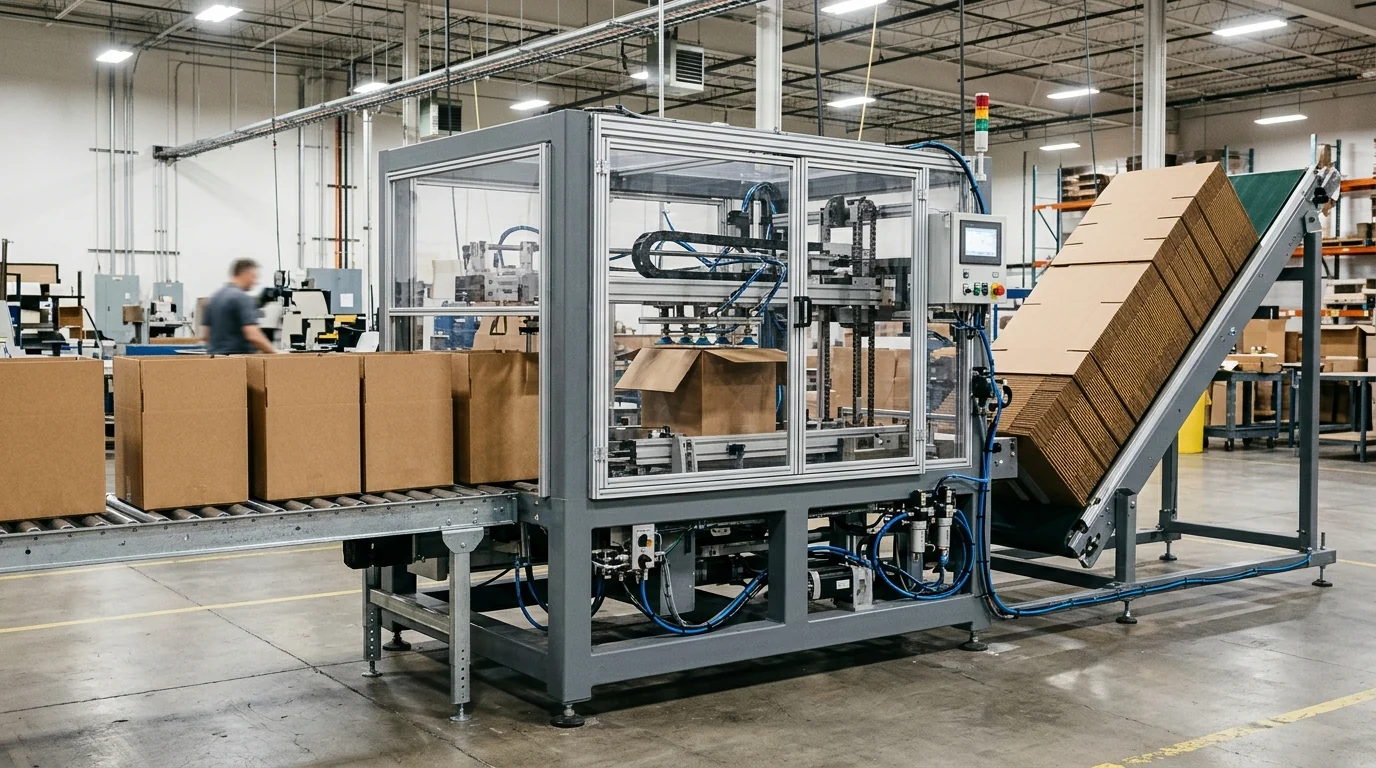
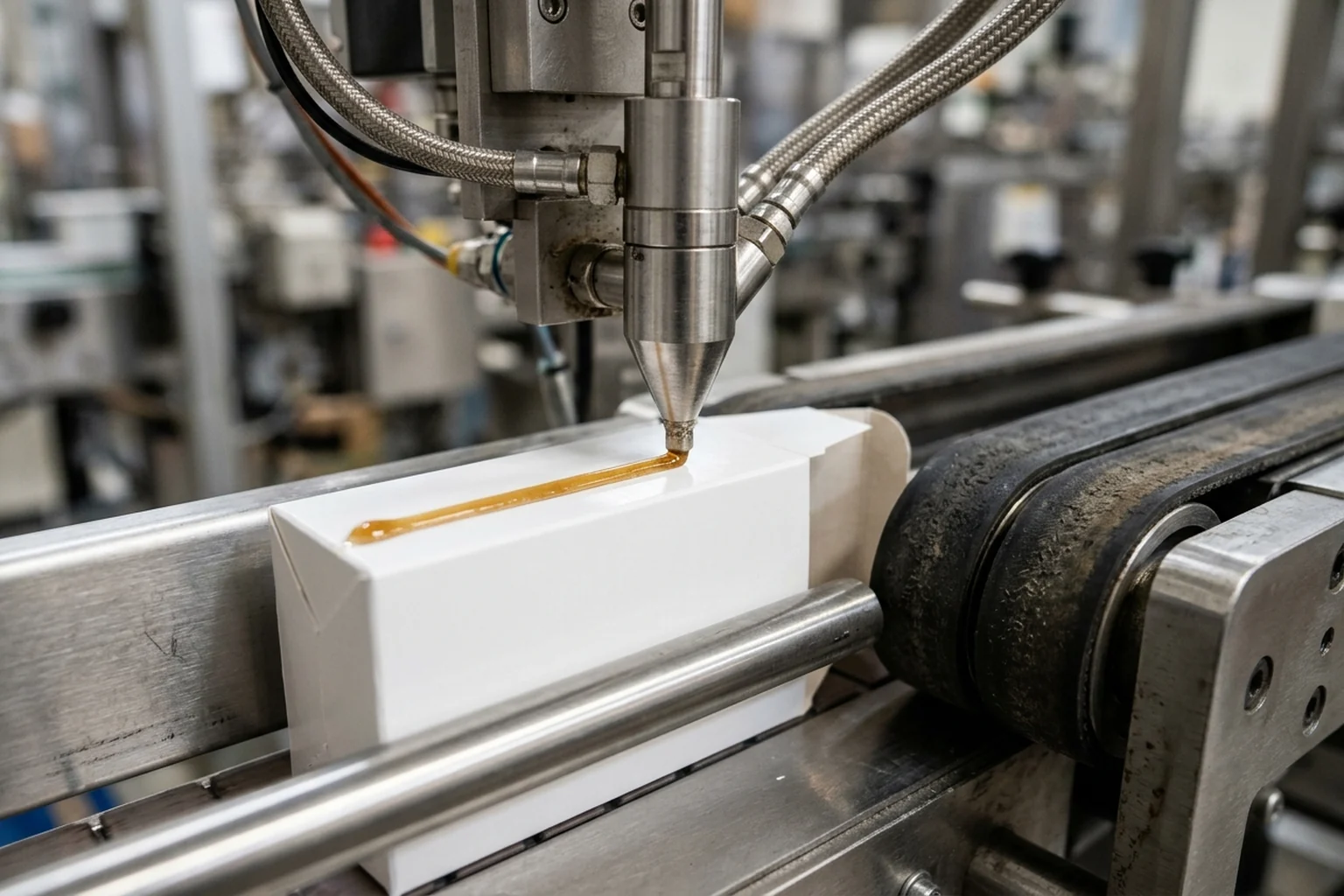
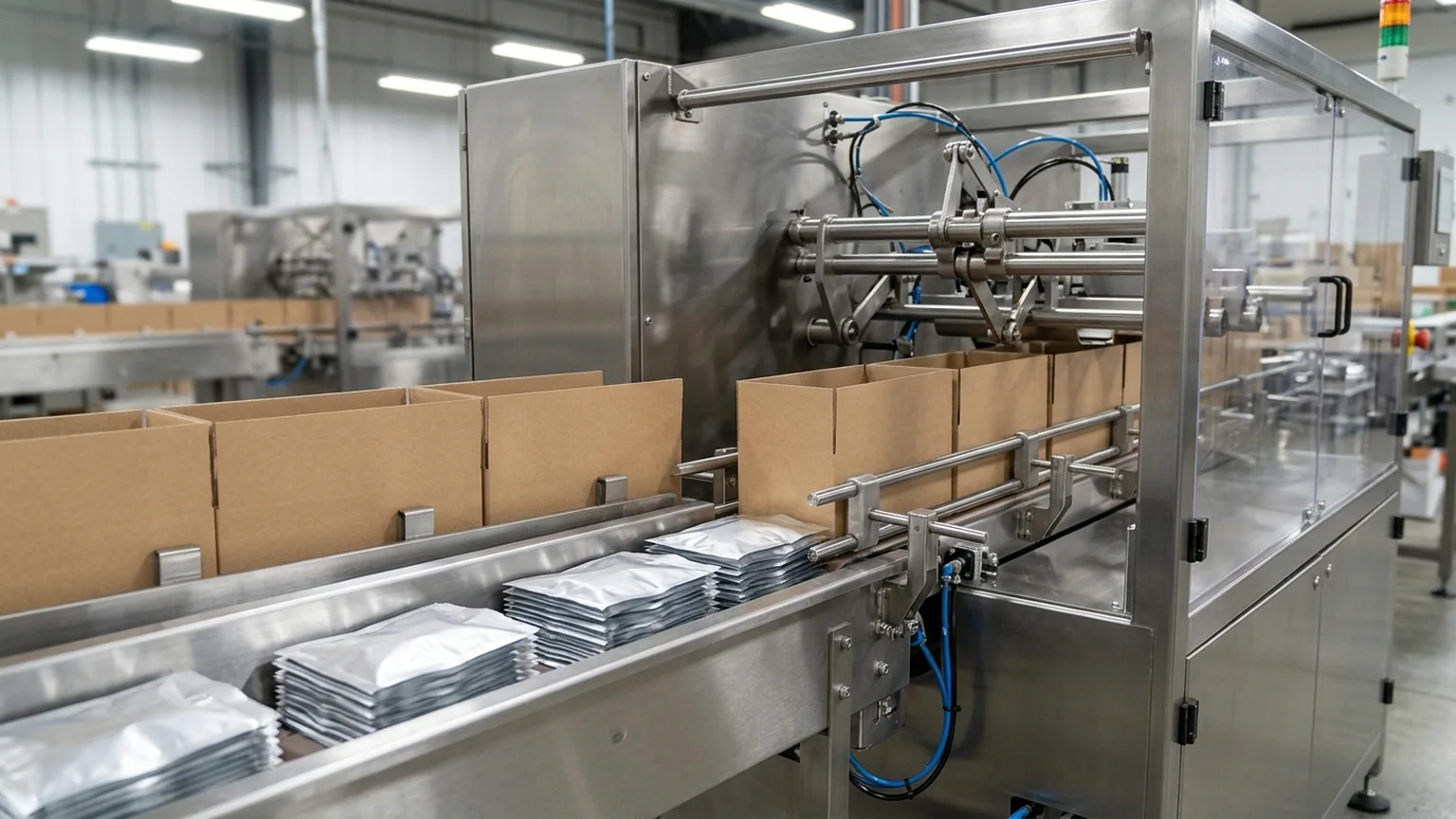
A motorized roller conveyor, also called a motorized drive roller (MDR) conveyor, embeds a brushless DC (BLDC) motor inside a conveyor roller tube and links that drive roller to a small group of non-powered rollers. Each controllable zone operates on demand when product is detected, delivering quiet zero-pressure accumulation across packaging machinery lines.
How Does a Brushless DC Motorized Roller Drive Slave Rollers Inside a Modular Zone?
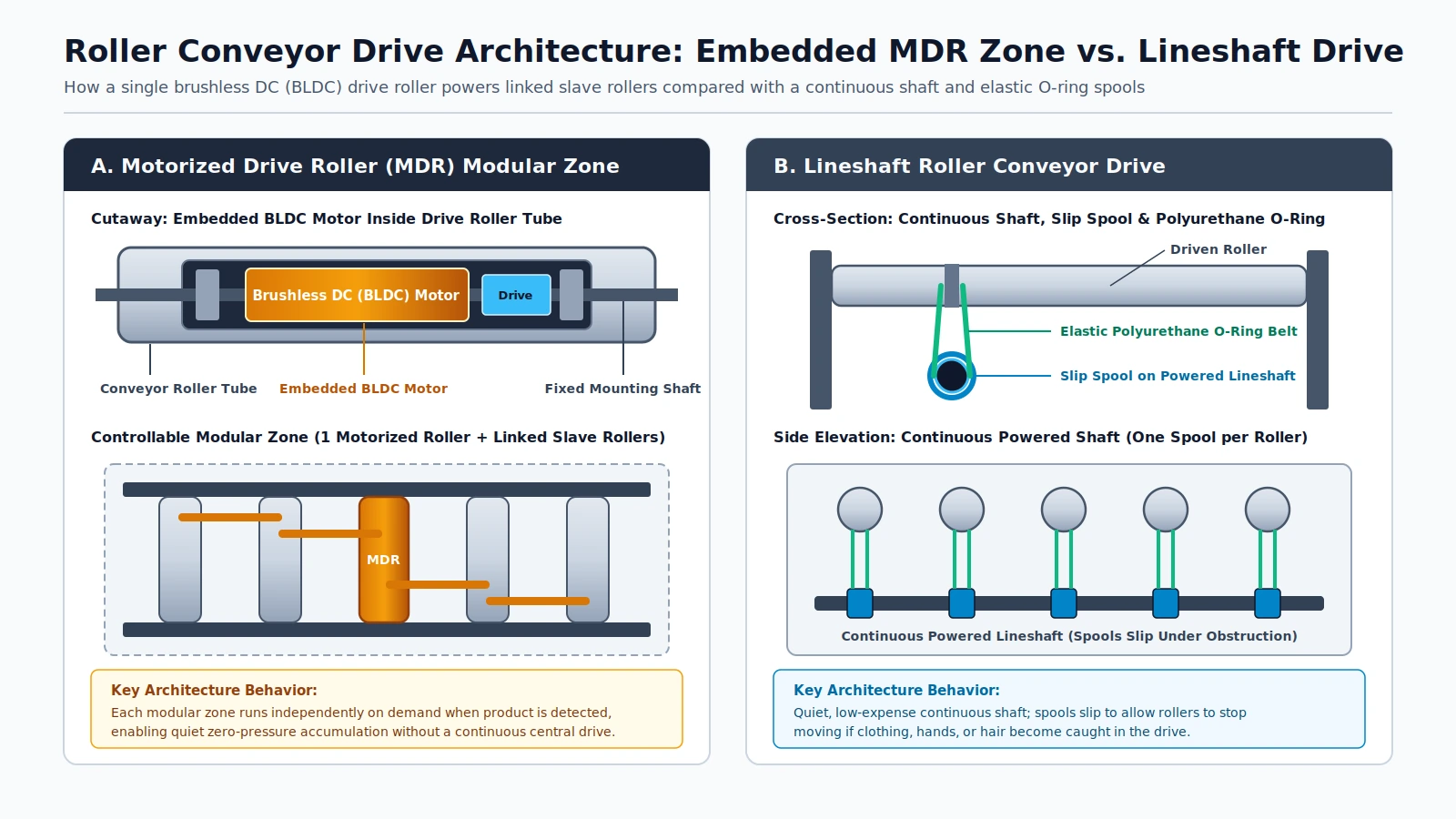
An internal brushless DC (BLDC) motor sits directly inside a single conveyor roller tube, turning that roller into a compact drive unit. According to the Wikipedia roller conveyor reference, that motorized roller tube is mechanically linked to a small number of non-powered rollers to create one independently controllable powered zone.
This modular zone layout contrasts sharply with a lineshaft roller conveyor. In a lineshaft system, a continuous rotating shaft runs beneath the bed and carries a series of spools, with one spool assigned to each roller. An elastic polyurethane o-ring belt runs from each spool on the powered shaft up to its corresponding roller to transmit rotational force.
Because an MDR conveyor divides the conveyor bed into self-contained zones rather than tying every roller to one mechanical shaft, packaging engineers can start, stop, or stage cartons in one zone without disturbing adjacent sections.
When Should Packaging Lines Choose Motorized Drive Rollers Over Lineshaft or Central Drives?
Packaging lines choose motorized drive rollers when quiet, low-maintenance, run-on-demand zone control and clean modular expansion outweigh the low upfront expense of a continuous lineshaft conveyor. Both architectures deliver quiet operation and straightforward installation, so the decision centers on zone-level accumulation control, slip behavior, and long-term maintenance scope.
Industry guidance from Jorgenson Material Handling notes that powered roller conveyors serve as a leading choice for easy installation and high-performance, low-maintenance operation without the need for spare parts, while controls, guarding, and future expansion belong in the initial conveyor design. By contrast, lineshaft roller conveyors stand out for quiet operation, easy installation, moderate maintenance, and low expense; their spools also slip to allow rollers to stop moving if clothing, hands, or hair become caught in them.
| Selection criterion | Motorized drive roller (MDR) conveyor | Lineshaft roller conveyor |
|---|---|---|
| Primary drive architecture | Brushless DC (BLDC) motor embedded inside a roller tube, mechanically linked to a small group of non-powered rollers | Continuous powered shaft with one spool per roller connected by an elastic polyurethane o-ring belt |
| Zone control and energy profile | Controllable zones with run-on-demand product detection for lower energy use and zero-pressure accumulation | Continuous shaft rotation across linked rollers without independent embedded zone motors |
| Mechanical slip and safety behavior | Relies on integrated zone controls, machine guarding, and emergency stops specified in the system design | Spools slip on the shaft so rollers stop moving if clothing, hands, or hair get caught |
| Maintenance and installation profile | Easy installation, high-performance low-maintenance operation without spare parts; scheduled inspection of rollers, belts, guards, controls, and stops | Easy installation, quiet operation, moderate maintenance, and low expense across shaft spools and o-ring belts |
Service Life and Preventive Inspection Discipline
Increasing the service life of any conveyor system depends on three fundamentals: choosing the right conveyor type, choosing the right system design, and paying consistent attention to regular maintenance practices. Teams should follow the manufacturer maintenance schedule and inspect rollers, belts, chains, guards, controls, and emergency stops before wear or misalignment interrupts production. Pairing conveyor checks with a structured packaging machine maintenance checklist keeps accumulation zones reliable across shifts.
How Do Run-on-Demand Zero-Pressure Accumulation Zones Buffer Downstream Packaging Stops?
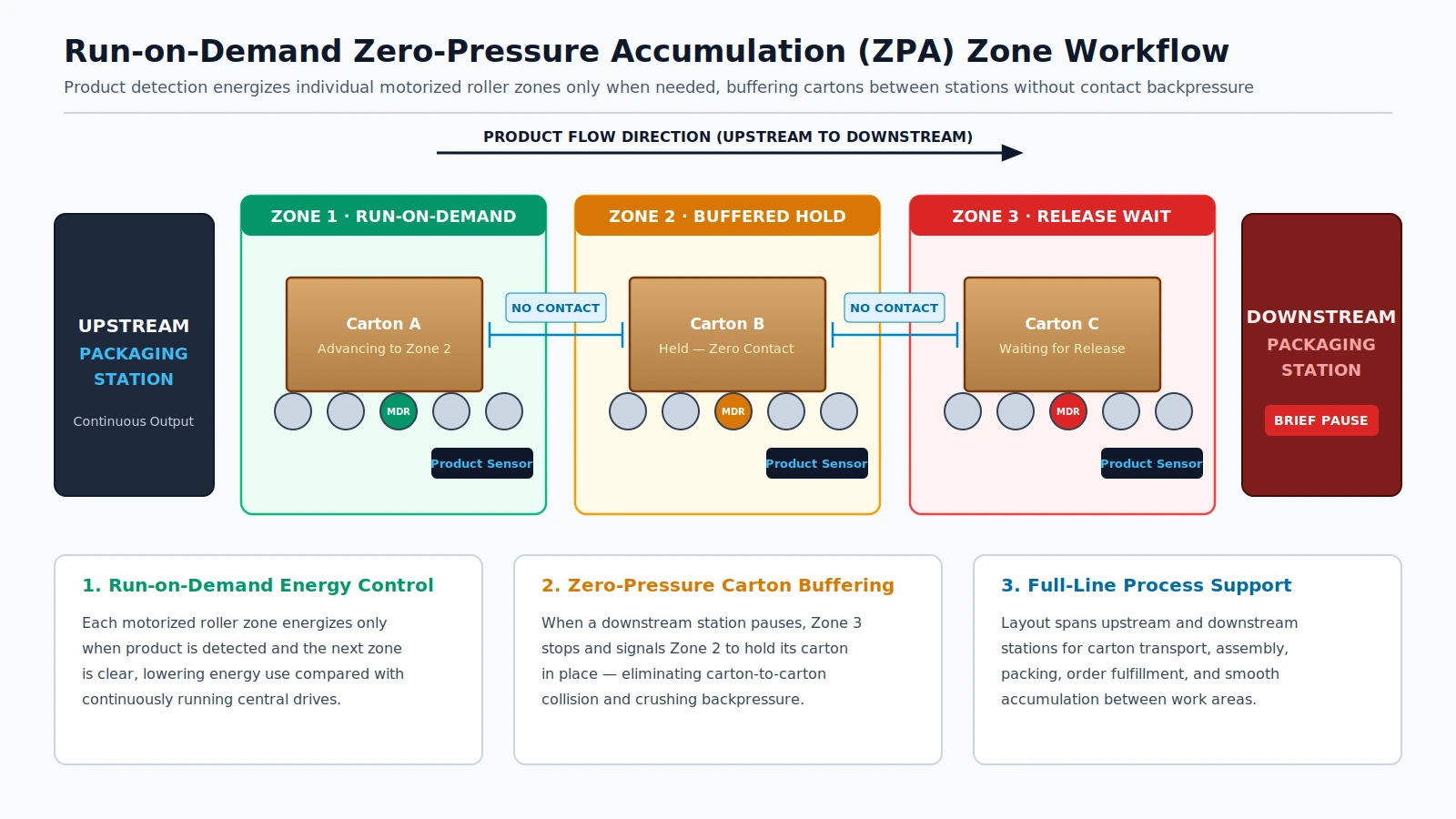
Run-on-demand powered roller zones detect cartons as they enter each section and energize rollers only when forward travel is needed, holding cartons in discrete zones with zero contact backpressure whenever a downstream station pauses. This buffering protects cartons while reducing unnecessary motor runtime across the packaging automation line.
Quiet powered roller conveyors combine zero-pressure accumulation with run-on-demand product detection for lower energy use. Because conveyor layout should support the full upstream and downstream process, engineers configure zone logic around four linked operating inputs: product, rate, path, and accumulation.
In active packaging facilities, these accumulation conveyors handle carton transport, order fulfillment, assembly, packing, accumulation, and controlled movement between work areas. When downstream equipment experiences brief micro-stops, staged zones absorb upstream output cleanly instead of forcing immediate upstream shutdowns—a core principle in balancing packaging line bottlenecks.
What Product Dimensions, Weight, and Installation Factors Govern Powered Roller Selection?
Product dimensions and weight determine the right conveyor type, while proper installation governs alignment, anchoring, load capacity, and safe operation across every roller bed. Whenever powered zone control is unnecessary for straightforward transfers, gravity roller conveyors remain an easy-to-use alternative across industries such as automotive and retail.
Material durability is equally decisive on live packaging lines. Conveyor systems require materials suited to the displacement of heavy loads and the wear-resistance needed to hold up over time without seizing due to deformation. Specifying durable roller surfaces and verifying frame alignment during installation prevent tracking drift and premature bearing wear.
| Engineering intake factor | What to verify on the packaging line | Design impact on conveyor specification |
|---|---|---|
| Product dimensions and weight | Carton footprint, load mass, and surface stability across all active packaging formats | Determines whether light-duty MDR, gravity rollers, powered belts, or heavy-duty live rollers fit the load |
| Rate, path, and accumulation | Required throughput, routing between work areas, and upstream-to-downstream buffering needs | Sets zone count, run-on-demand control logic, and future expansion allowances |
| Roller material and wear resistance | Load displacement demands and operating duty cycle across shifts | Ensures roller tubes and bearings resist wear without seizing due to deformation |
| Installation alignment and anchoring | Floor anchoring, bed levelness, guarding clearances, and emergency stop access | Directly governs structural alignment, anchoring security, rated capacity, and safe operation |
When Must Flexible Pouches or Steep Inclines Stay on a Powered Belt Conveyor?
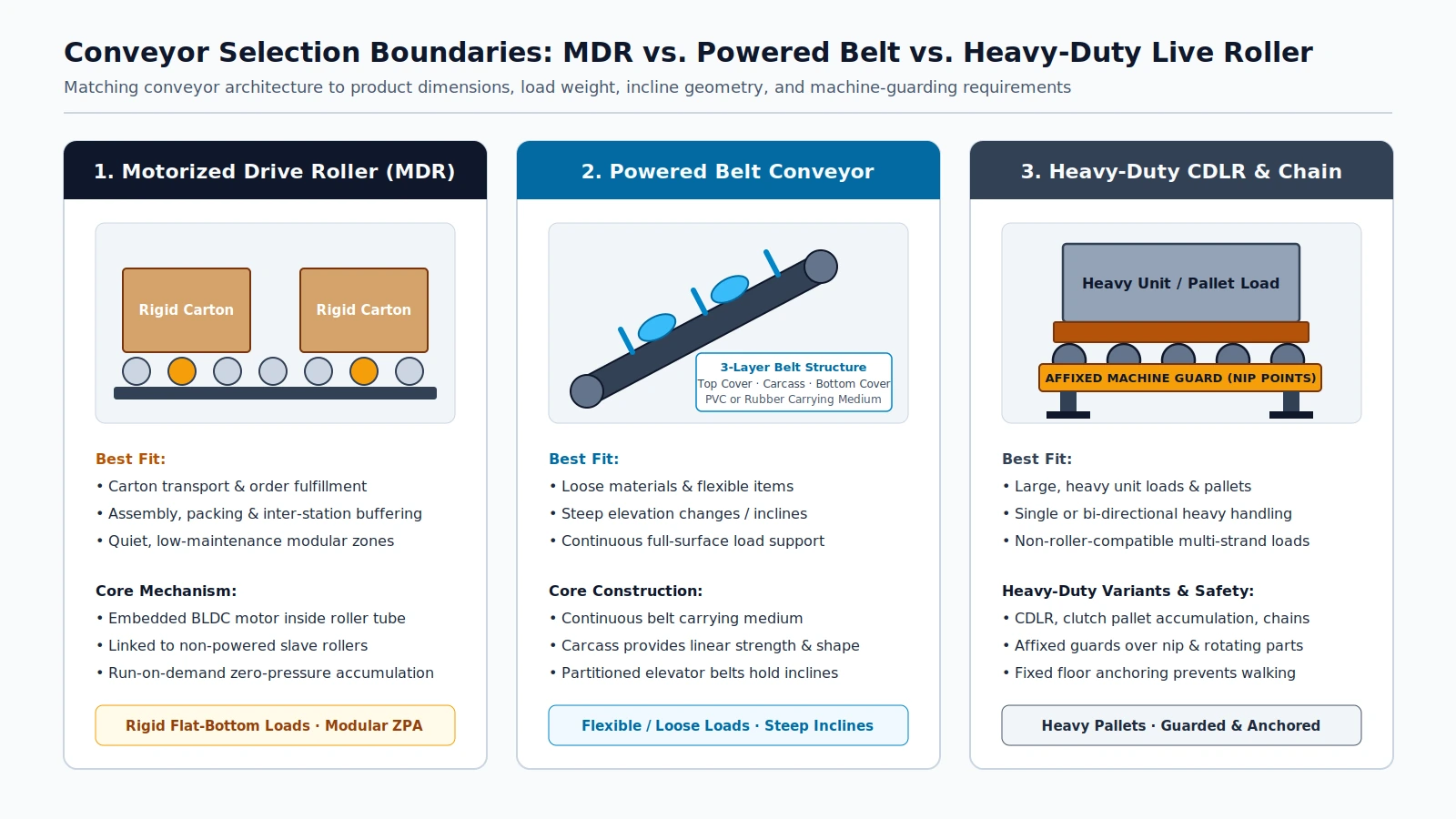
Loose materials, soft flexible items, and steep elevation changes belong on a powered belt conveyor rather than an open roller bed because the belt provides a continuous carrying medium across its entire length. As documented in the Wikipedia conveyor belt overview, belts with regularly spaced partitions—known as elevator belts—are specifically used to transport loose materials up steep inclines.
Conveyor belts are manufactured in PVC and rubber materials tailored to different conveyed products. It is common for industrial conveyor belts to use a three-layer construction consisting of a top cover, a carcass, and a bottom cover, where the carcass provides linear strength and dimensional shape under tension. Wherever flexible packages or uneven items could sag or catch between roller gaps, switching to a continuous belt surface eliminates transfer jams.
When Do Heavy Loads and Pallets Require Chain-Driven Live Rollers and Machine Guarding?
Large, heavy unit loads and loaded pallets exceed light-duty carton roller beds and require heavy-duty chain-driven live roller (CDLR) conveyors, mechanical-clutch pallet accumulation conveyors, or multi-strand chain conveyors. All fixed industrial conveyors must be securely anchored and protected with affixed machine guarding over ingoing nip points and rotating parts under OSHA general machine guarding requirements.
Heavy-Duty Live Rollers, Mechanical-Clutch Pallet Accumulation, and Multi-Strand Chains
Heavy-duty roller conveyor families extend powered transport well beyond standard shipping cartons:
- Chain-driven live roller conveyors handle single or bi-directional material handling and move large, heavy loads across high-mass packaging and palletizing zones.
- Pallet accumulation conveyors are powered through a mechanical clutch to stage heavy unit loads safely.
- Multi-strand chain conveyors run double-pitch roller chains to move products that cannot be transported on traditional roller conveyors.
- Chain and roller transfers integrate short runs of two or more strands of double-pitch chain conveyors directly into a chain-driven live roller conveyor for right-angle load transfers.
Machine Guarding and Fixed Anchoring Requirements
Under federal OSHA machine guarding standards, one or more methods of machine guarding shall be provided to protect operators and nearby employees from hazards created by the point of operation, ingoing nip points, rotating parts, flying chips, and sparks. Guards shall be affixed directly to the machine where possible, and secured elsewhere if machine attachment is not possible.
Additionally, the point of operation on any machine whose operation exposes an employee to injury shall be guarded, and machines designed for a fixed location shall be securely anchored to prevent walking or moving during operation.
| Conveyor family | Target load profile | Drive and carrying mechanism | Primary operational strength |
|---|---|---|---|
| Motorized drive roller (MDR) | Rigid cartons in packing, assembly, and order fulfillment | Embedded BLDC drive roller linked to non-powered slave rollers | Quiet run-on-demand zero-pressure accumulation with lower energy use |
| Powered belt / elevator belt | Loose materials, flexible packs, and steep inclines | Continuous PVC or rubber three-layer belt (top cover, carcass, bottom cover) or partitioned belt | Full-surface support and incline retention without roller gaps |
| Chain-driven live roller (CDLR) | Large, heavy unit loads and pallets | Chain-driven heavy-duty rollers (single or bi-directional) | High-mass load displacement with wear-resistant structural components |
| Pallet accumulation and multi-strand chain | Loaded pallets and non-roller-compatible heavy loads | Mechanical-clutch pallet accumulation or multi-strand double-pitch roller chains | Heavy pallet staging and transfer where traditional rollers cannot support the load |
Sources
- Wikipedia — Roller conveyor & Motorized Drive Roller (MDR)
- Wikipedia — Lineshaft roller conveyor
- Wikipedia — Conveyor belt
- OSHA — General requirements for all machines
- Jorgenson Material Handling — Powered Roller Conveyor