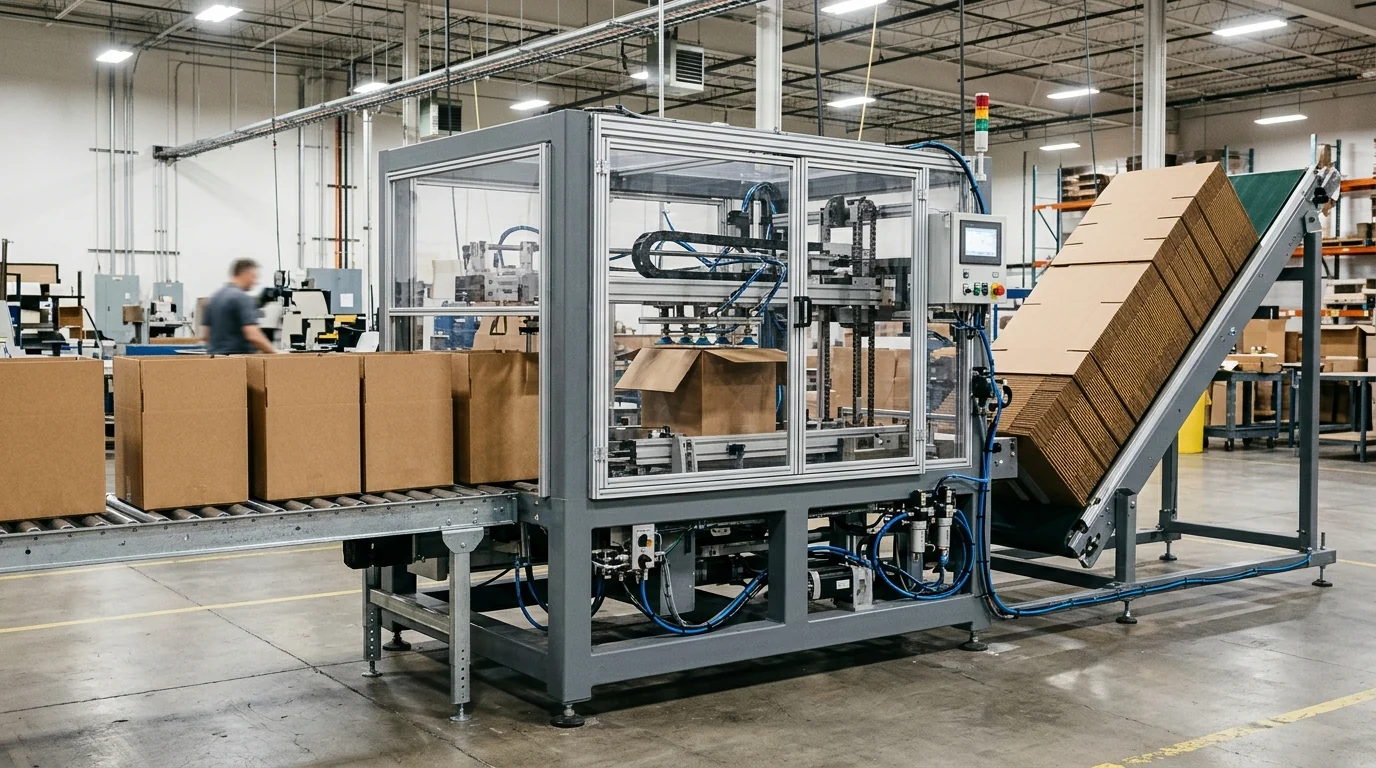
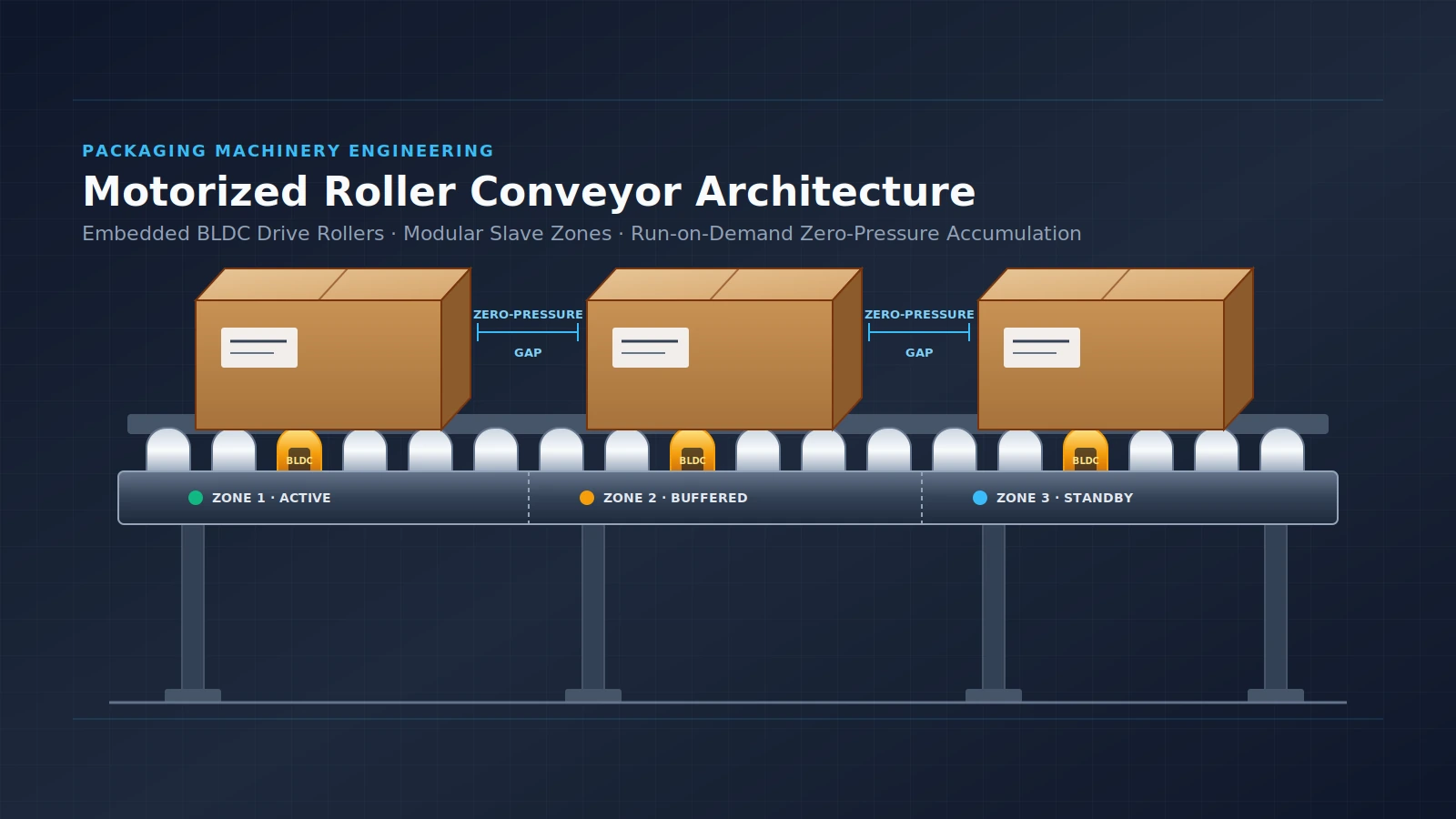
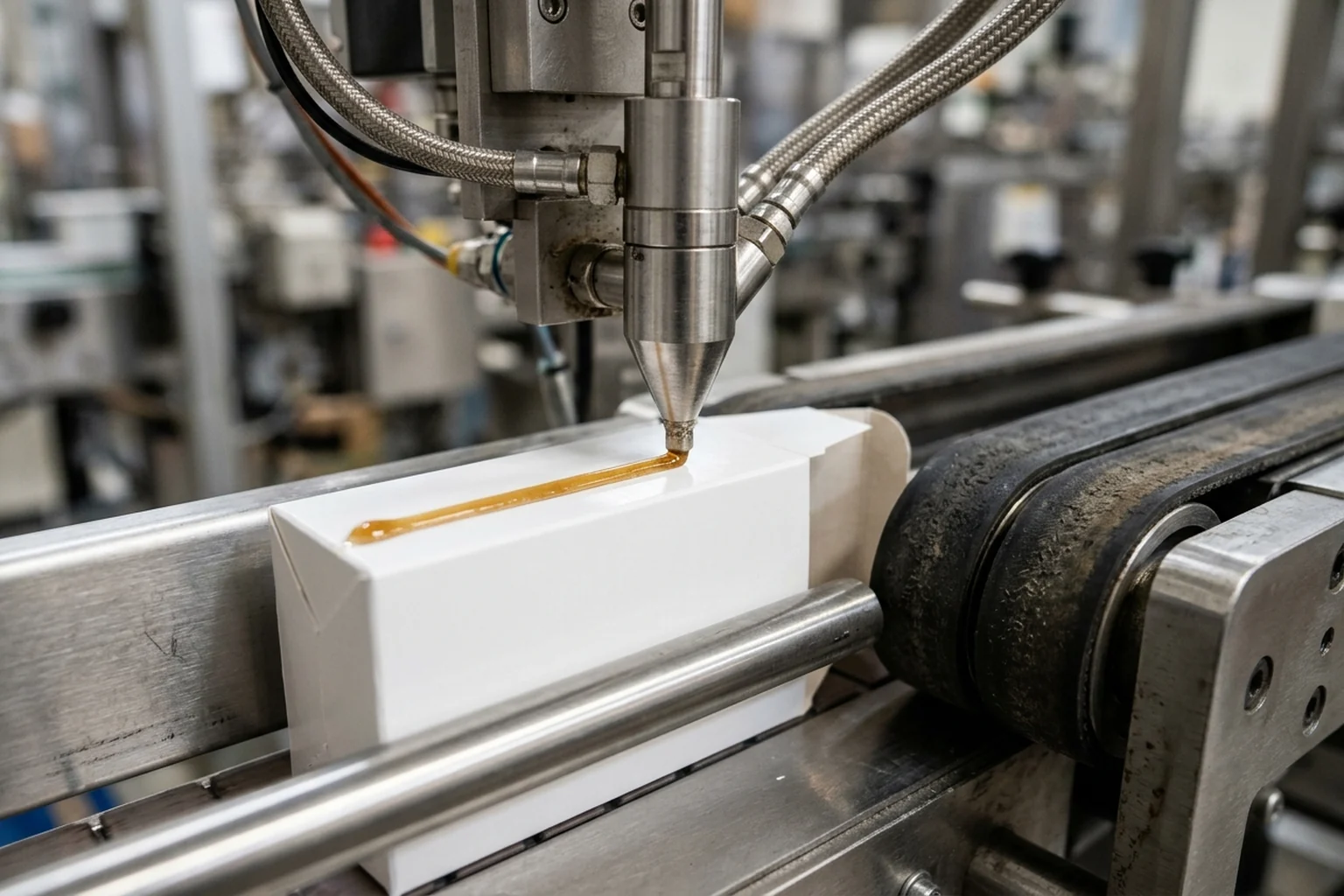
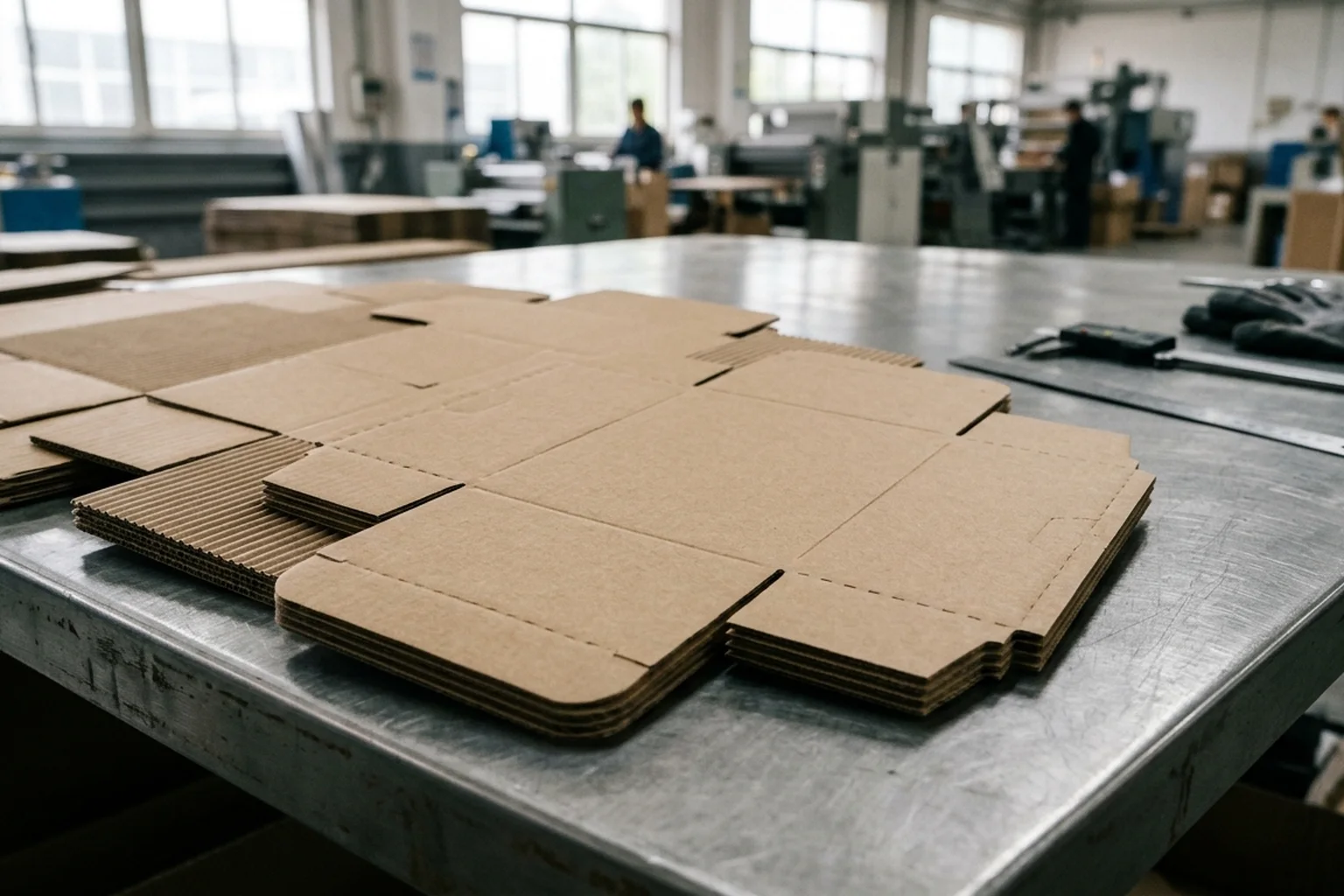
Evaluating packaging automation for paper products requires matching board specifications, vacuum pickup mechanics, and magazine separation across your packaging machinery line. Porosity is defined as the amount of outside atmosphere that passes through an object under vacuum, and paper contains tiny pores that leak considerable air into vacuum systems. Excess adhesive squeezed onto inside blank surfaces during box production can cure while the blank lies flat, gluing the insides together so it cannot open in a case erector or tray former. If box flaps are not scored precisely or deeply enough, they can fold incorrectly and force the box out of square. If manufacturer glue joints are not glued straight during manufacture, the box can open out of square in a case erector.
Paperboard and Corrugated Blank Defects at the Infeed Boundary
Before sizing a carton erector or tray former, review how converting quality, fiber composition, and transport moisture affect incoming blanks alongside your plant-wide packaging automation checks.
| Blank variable | Verified material and forming behavior |
|---|---|
| Fiber length | Recycling paper shortens its structural fibers, resulting in corrugated board that is weaker than an identical product made from virgin stock. |
| High-speed feeding | Weaker corrugated blanks with shortened recycled fibers can jam in a case erector or tray former, especially when running at high speeds. |
| Transport moisture | Corrugated blanks that misfeed and jam may have been compromised in transport by exposure to water or high humidity. |
| Recycled content | Graphic Packaging's PaceSetter Ridgeline uncoated recycled paperboard is made from 100% recycled fibre and contains at least 45% post-consumer recycled content. |
| Caliper range | Graphic Packaging's PaceSetter Ridgeline uncoated recycled paperboard is produced at its Texas mill in 14- to 30-point calipers. |
Vacuum Suction Cup Selection and Porosity Compensation for Paper and Board
Compare suction cup durometer, vacuum level, pump flow, and flow-restrictor selection when designing vacuum handling for paper and corrugated board.
Suction Cup Durometer, Safety Factor, and Evacuation Level
Use these vacuum design parameters when sizing cups and pumps for porous sheets:
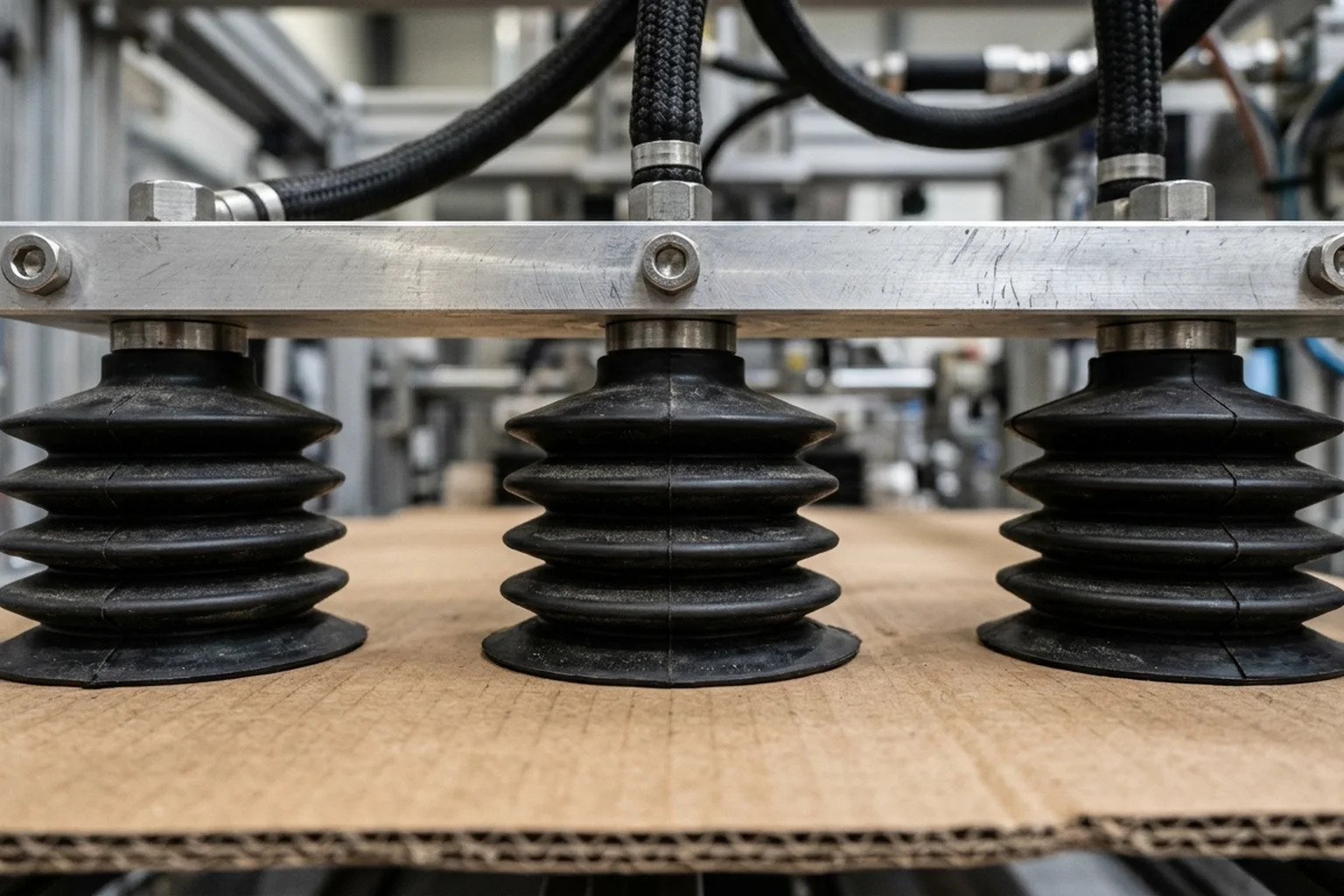
- Soft or low-durometer suction cups usually seal more effectively against grainy or rough-textured surfaces, but increased body flexibility can decrease stability during handling.
- A dual-durometer suction cup, usually with a 30-durometer lip and 50-durometer body, can improve compliance while retaining stability.
- Vacuum suction cup designs should incorporate a safety factor greater than two.
- In vacuum suction cup evacuation, the greater part of evacuation time occurs above 12-in.Hg.
- A 3-in. bellows-style suction cup at 6-in.Hg handles 16.6 lb, the same load as a 2-in. cup at 18-in.Hg.
- Corrugated boxes have pores that allow ambient atmosphere to leak into a vacuum system, requiring a larger pump with more flow to compensate for porosity.
- Increasing vacuum level from 18- to 27-in.Hg requires ten times as much energy and makes the system more susceptible to operating problems from leakage and porosity.
Metered-Orifice Flow Restrictors and Multi-Fold Bellows Cups
Compare check-valve behavior, flow restrictors, and bellows cup specifications on corrugated and paper substrates:
- For porous corrugated cardboard handling, the air leakage rate depends on the porosity, texture, and rigidity of the corrugated cardboard and the pressure differential (vacuum level).
- Airflow through some porous corrugated cardboard can be high enough to close a check valve even if the vacuum cup seals on the surface, so Schmalz uses a metered-orifice flow restrictor.
- Schmalz sizes metered-orifice flow restrictors in fractions of a millimeter for layer grippers using 500 to 1000 vacuum cups.
- The J. Schmalz GmbH FSGC bellows suction cup combines a flexible suction cup neck with 4.5 folds for an increased stroke when handling cardboard boxes, paper, and poly bags.
- The Schmalz FSGC bellows suction cup is made of NBR and is available in outer diameters of 40, 50, and 60 millimetres.
Magazine Blank Separation, Pre-Breaking, and Positive Forming Control
Review how case erectors, intermittent horizontal cartoners, and top-load carton formers regulate magazine delivery and carton erection.
Powered Magazine Infeed, Separation Retainers, and Hinged Framing
Compare magazine separation and square-forming mechanisms across case and carton equipment:
- Lantech’s Blank Delivery Control System uses powered infeed belts in the magazine to regulate blank delivery speed to the pick-up arm and prevent jams from early misfeeds.
- Lantech’s Blank Separation System uses multiple separation retainers to space blanks for a vertical feed one blank at a time, synchronized with the pick-up arm.
- Lantech’s Square Case Delivery System uses a hinged pick-up frame outfitted with eight vacuum-powered suction cups that grip two panels firmly to form the case at a 90° angle.
- Lantech’s Total Control System folds flaps while the case is immobile; a single pusher bar slides the squared case into spring-loaded, motor-synchronized dual-side exit belts that preserve squareness.
- The ELMACH WKH-100 Intermittent Motion Horizontal Cartoner uses an intelligent built-in pre-breaking carton erection system to ensure consistent carton opening.
Horizontal End-Load Cartoner, Auto Bottom Carton, and Top-Load Carton Former Architectures
Compare published feeding, indexing, and forming specifications when evaluating horizontal cartoners, auto bottom carton equipment, and top-load carton formers:
- The Bartelt BIC-L Cartoner (formerly IMC) is a servo-driven horizontal intermittent-motion cartoner with a multi-head rotary carton feeder, delivering speeds up to 60 cycles per minute.
- The Bartelt BIC-L Cartoner uses servo-driven technology with 50% fewer components than traditional chain shaft systems.
- The Bartelt BIC-L Cartoner is available in three standard index models: 6”, 9”, and 12”.
- On the Bartelt BIC-L Cartoner, folded pre-glued cartons are placed into a horizontal powered magazine and removed from the bottom by a servo-driven two-head rotary feeder with vacuum cups on spindles.
- Depending on machine pitch and application, the Bartelt BIC-L Cartoner operates at speeds up to 120 cartons per minute and includes photo-eye carton presence and end-flap detection.
- The Bartelt VP-1 Variety Pack Cartoner is a servo-driven intermittent-motion horizontal end-load system that achieves speeds up to 40 cartons per minute depending on product and configuration.
- The Bartelt VP-1 Cartoner features up to 8 operator load stations with individual safety lines, a retainer mechanism during indexing, and a pressure-control magazine that automatically advances blanks.
- The Syntegon Kliklok ACE carton former reaches up to 240 cpm with lock, glue, or ultrasonic forming and an integrated Flex Feeder for positive carton control.
- The Syntegon Kliklok ACE carton former runs at up to 80 cycles per minute with a single, double, or triple head.
- A double-head Syntegon Kliklok ACE carton former for typical carton sizes runs at 60 cycles per minute with an output of 120 cartons per minute using a lock closure.
- The Syntegon Kliklok ACE carton former handles carton blank sizes from 190 mm length x 122 mm wide to 800 mm length x 600 mm wide in paperboard or corrugated material.
- The Syntegon Kliklok ACE carton former features a waist-height manually loaded carton hopper, tool-less changeovers, and an IP 54 rated open-frame stainless-steel design.
Comparing Inline and Standard Case Erector Specifications
Compare published model specifications across inline and standard automatic case erector configurations in the table below.
| Model category | Verified manufacturer specification |
|---|---|
| CI2000 standard speed | The Lantech CI2000 Inline Automatic Case Erector has a standard throughput speed of 8 Cases/Minute, with an 18 cpm option. |
| CI2000 high-speed option | The Lantech CI2000 High Speed Package option increases speed to a maximum of 25 cases per minute. |
| CI2000 case dimensions | The Lantech CI2000 handles outside case dimensions from 200 mm L x 150 mm W x 150 mm C minimum to 620 mm L x 450 mm W x 650 mm C maximum. |
| CI2000 magazine and air | The Lantech CI2000 has an approximate magazine infeed capacity of 200 cases and requires a 6 Bar (80 Psi) air supply. |
| CI2000 flutes and sealing | The Lantech CI2000 runs RSC, HSC, FEFCO 0200/0201 cases in B, C, E or combination flutes (single and double wall) with Lantech TH-Series tape or Robatech/Nordson hot melt. |
| C400 speed and dimensions | The Lantech C400 Automatic Case Erector has a throughput speed of 8 Cases/Minute and handles outside case dimensions from 200 mm L x 150 mm W x 250 mm C minimum to 620 mm L x 450 mm W x 650 mm C maximum. |
| C400 flutes and sealing | The Lantech C400 runs RSC, HSC, FEFCO 0200/0201 cases in B and C flutes (single and double wall) with Lantech TH-Series tape sealing, while hot melt sealing is Not Available. |
Downstream Paper Void Fill Dispensing and Operator Changeover Scope
Coordinate downstream paper void fill machine settings with operator changeover responsibilities defined in your packaging machine operator training program.
- In Lantech case erectors, failed box pickup, dropped cases during opening, and inconsistent squaring have common root causes of clogged vacuum filters, worn suction cups, and vacuum line air leaks.
- In Lantech case erectors, double picks from the magazine, failure to feed blanks, and erratic indexing have common root causes of poor blank quality, improper magazine loading, and guide misadjustment.
- At Lantech case erector startup, operators are trained on start/stop and emergency stop procedures, box-size changeover, adjustment of the six primary setup points, and tape loading; box-specific cheat sheets guide size changes.
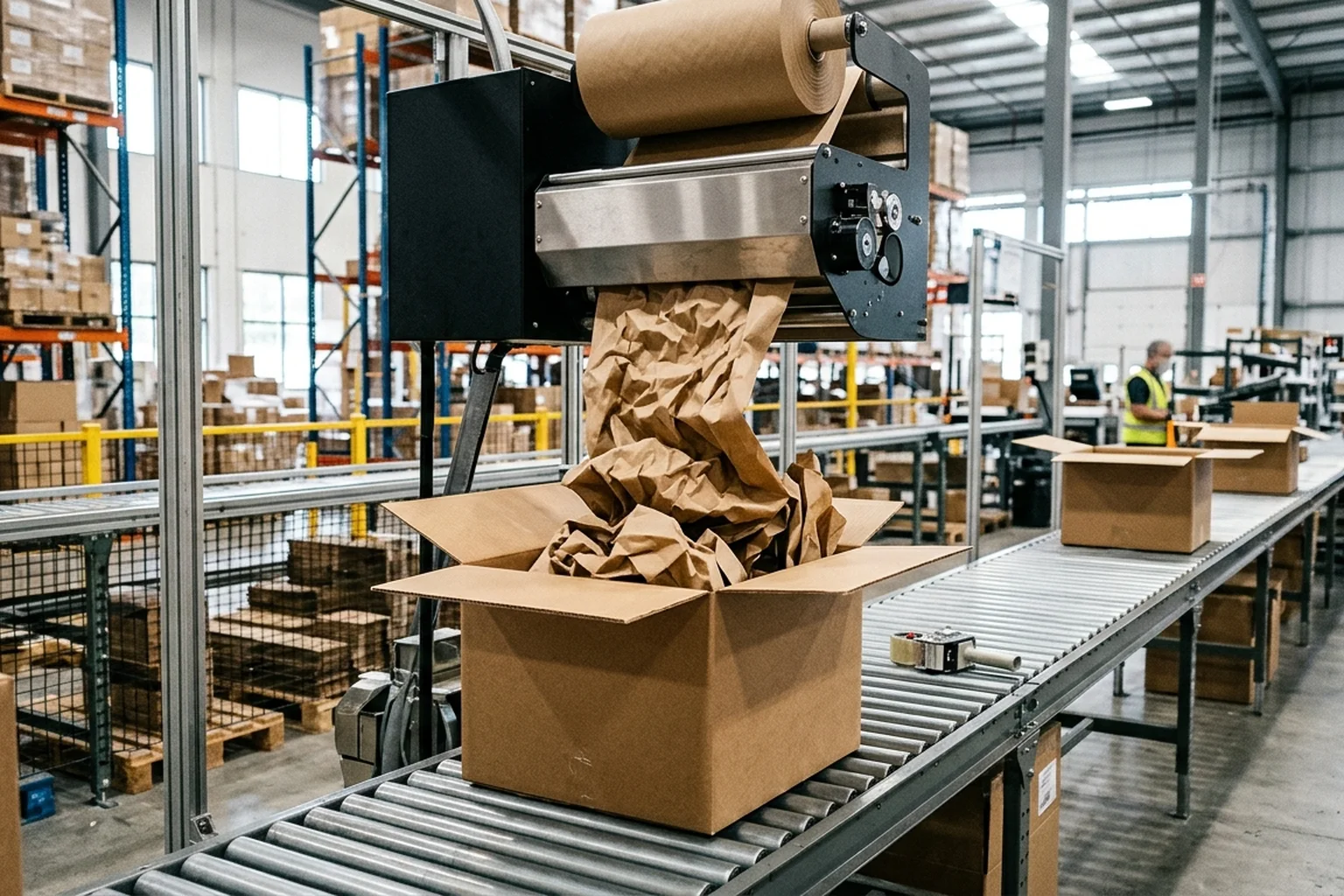
- The Pregis EasyPack Strata on-demand paper system forms structured paper pads for void fill, light cushioning, and full cushioning at dispensing speeds of up to 60 inches per second.
- The Pregis EasyPack Strata allows operators to choose single- or dual-ply paper and adjust basis weight, running Pregis EasyPack paper made from 100 percent recycled content including FSC-certified options.
Paper and Carton Infeed Qualification Worksheet
Record these substrate, blank, and throughput fields in your qualification log before running an equipment trial.
| Worksheet field | What to record on the line | Verification question |
|---|---|---|
| Substrate grade and caliper | Virgin or recycled fiber composition, caliper range, or flute profile | Does the board specification match the target carton former or case erector? |
| Flat and formed dimensions | Flat blank length and width alongside erected outside dimensions | Do minimum and maximum dimensions fall within the published model range? |
| Scoring and glue joints | Flap score depth, inside adhesive clearance, and joint straightness | Do incoming blanks open square without inside panels sticking together? |
| Transport and storage condition | Exposure to water or high humidity during transit and warehousing | Are blanks stored under controlled conditions prior to magazine loading? |
| Vacuum pickup configuration | Suction cup diameter, durometer, bellows folds, and vacuum level | Does cup sizing maintain the required safety factor without excessive vacuum depth? |
| Magazine and forming method | Powered belts, separation retainers, rotary vacuum spindles, or pre-breaking | How are blanks separated one at a time and held square during flap folding? |
| Infeed and void fill rate | Manual infeed cadence, target cases or cartons per minute, and paper pad ply | Are upstream erection speed and downstream paper pad dispensing balanced? |
Sources
- Combi Packaging Systems — Most Troubles with Automated Box Forming Aren’t the Machine, It’s the Corrugated
- Packaging Europe — Graphic Packaging unveils first uncoated recycled paperboard (PaceSetter Ridgeline)
- Power & Motion Tech — Designing with vacuum and suction cups
- Power & Motion Tech — Suction cups hold on tight
- Schmalz — New bellows suction cup for fast sorting (FSGC)
- Lantech — Take Control of Case Erecting: How the Total Control System Transforms Packaging Efficiency
- Packaging Strategies — Intermittent Cartoner for Pharmaceutical and Cosmetic Packaging (Elmach WKH-100)
- Bartelt Packaging — Servo-Driven Cartoning Solution with Multi-Head Feeder (Bartelt BIC-L / IMC Cartoner)
- Bartelt Packaging — Servo-Driven Horizontal Cartoning: Bartelt VP-1 Variety Pack Cartoner
- Syntegon — Syntegon Technology launches Kliklok ACE carton former
- Lantech — CI-2000 Inline Automatic Case Erector
- Lantech — C-400 Automatic Case Erector
- Lantech — Case Erector Maintenance Requirements: Skills, Tools, and Preventive Care You Need
- Packaging Strategies — Pregis Launches EasyPack Strata for Efficient Void Fill Applications