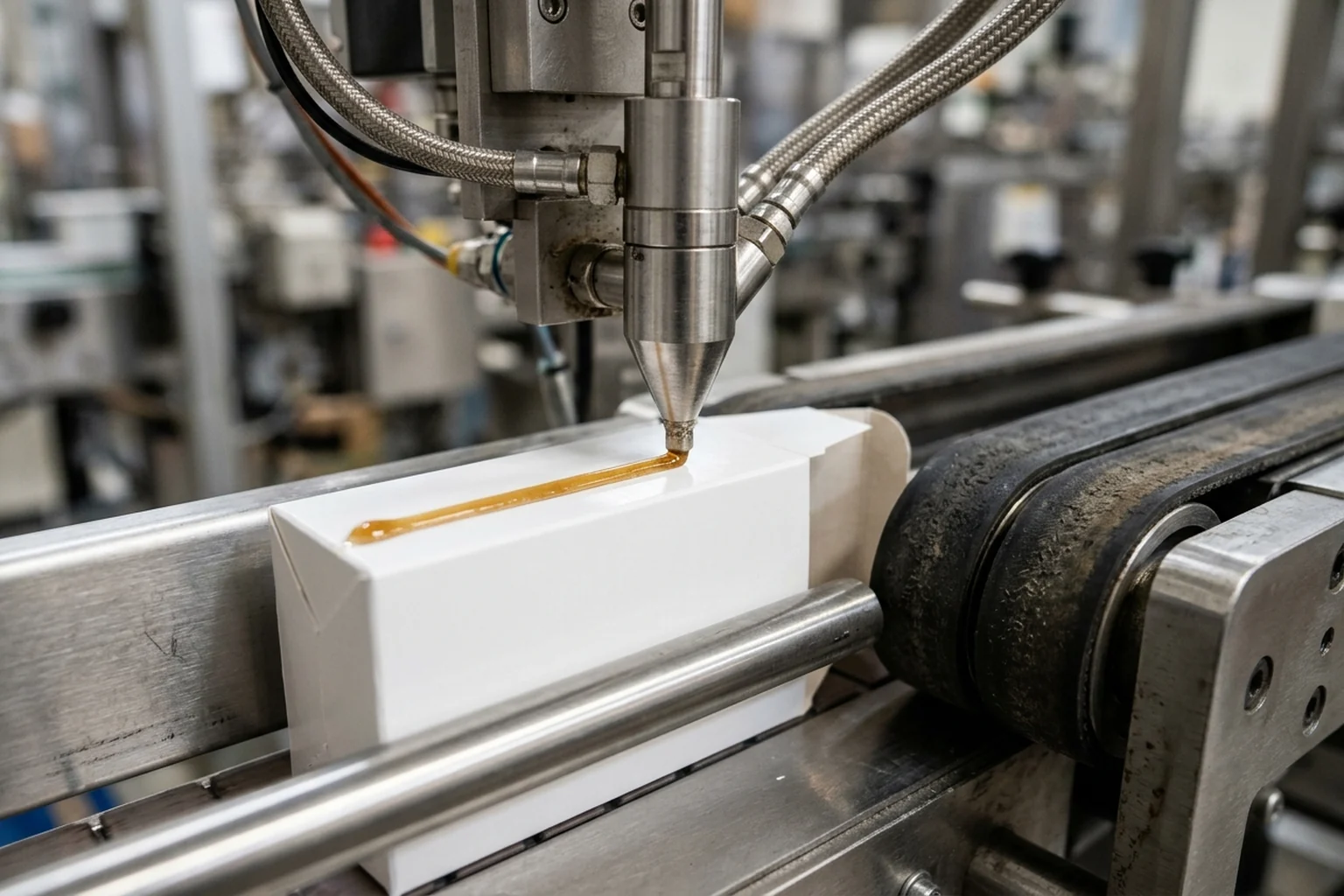
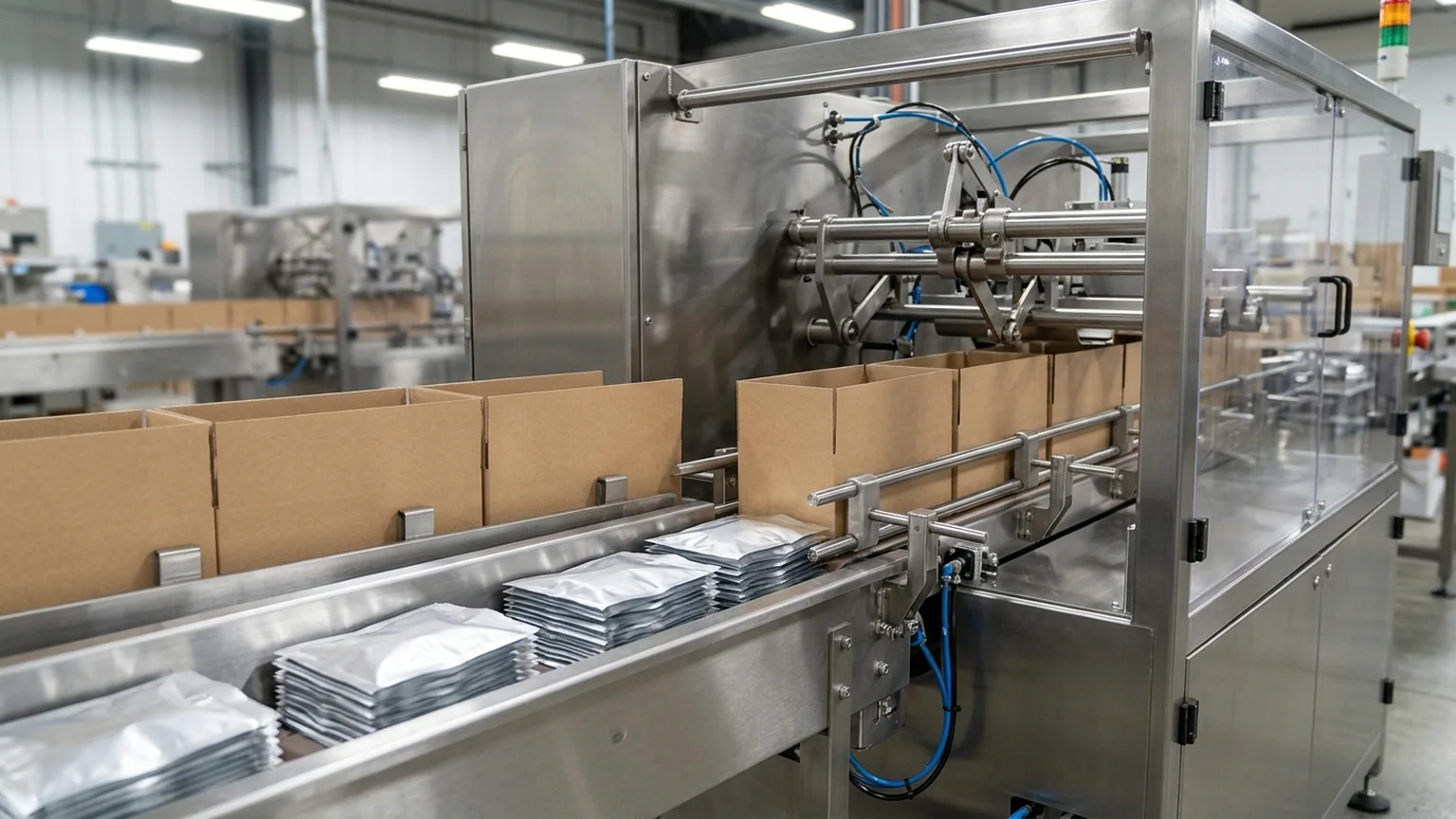
An automatic carton erector, also called a case erector or case former, pulls flat knock-down corrugated blanks from a powered magazine, breaks board scores into a crisp 90° square box, folds the bottom flaps, and seals the base with pressure-sensitive tape or hot-melt adhesive. Delivering upright, square shipping containers stabilizes downstream packing across packaging machinery lines.
How Does a Carton Erector Separate, Open, and Square Corrugated Blanks?
A carton erector achieves repeatable 90° squareness by metering one knock-down blank at a time from a powered magazine, gripping two panels simultaneously to overcome crease memory, folding bottom flaps while the box stays restrained, and transferring the erected case between synchronized dual chains or spring-loaded side belts.
Magazine Blank Delivery and Single-Blank Separation
Uncontrolled blank stacks frequently double-feed or skew before reaching the forming bay. Lantech’s Blank Delivery Control System uses powered infeed belts in the magazine to regulate blank delivery speed to the pick-up arm, preventing jams from early misfeeds while allowing ergonomic walk-in loading. Upstream of pickup, multiple separation retainers space blanks correctly for a vertical feed one blank at a time synchronized with the pick-up arm’s readiness.
A-B-C Packaging builds its erectors around robust tubular steel frames and powerful mechanical drives so continuous knock-down corrugated case feed, smooth opening, and precise transfer through sealing operate in unison. For plants evaluating suction cup sizing, durometer, and porosity leakage on kraft and recycled sheets, review our dedicated guide to packaging automation for paper products blank separation and infeed.
Dual-Opposed Vacuum Frames, Hinged Multi-Cup Pickers, and Mechanical Squaring
Single-sided suction often stalls when board stiffness or warped creases resist opening. Equipment builders counter springback through three proven opening mechanisms:
- Dual opposed vacuum opening: On the Pearson CE35 and CE50, a dual opposed vacuum force grasps both sides of the knock-down blank simultaneously to open the case reliably, and a synchronized dual chain drive carries the box through the closing and sealing section so completed cases exit square.
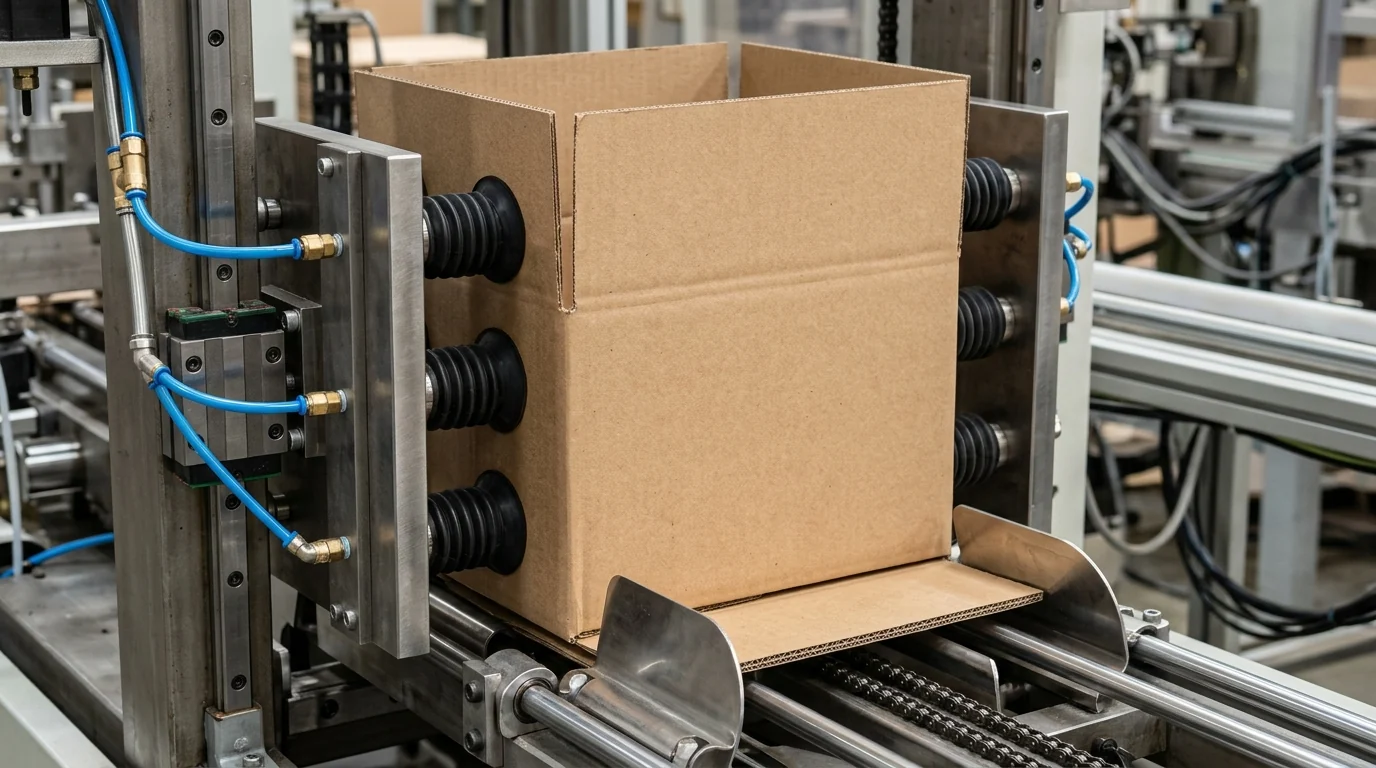
- Hinged multi-cup pickup frames with stationary flap folding: Lantech’s Square Case Delivery System uses a hinged pick-up frame outfitted with eight vacuum-powered suction cups that grip two panels firmly to form a 90° angle. Bottom flaps are folded while the case is immobile, and a single pusher bar slides the squared case into spring-loaded, motor-synchronized dual-side exit belts that adapt to width variations without crushing the walls.
- Belt-driven mechanical opening with pneumatic flap arms: The Wexxar WF30 LTR case former combines a belt-driven transport with mechanical case-opening mechanisms, case squaring, and pneumatic folding arms to hold uniform geometry up to 30 cases per minute.
Holding case squareness directly protects pallet stability downstream. Lantech notes that un-square cases lose 30% of their stacking strength when stacked on a pallet. In its Total Control System comparison, Lantech contrasts ±5–7 mm (±0.20–0.28 in.) typical squareness deviation, 4–6 unplanned downtime incidents per 1,000 cases, and up to 8% blank jam rates on lower-quality blanks against ±1 mm (±0.04 in.) or less squareness accuracy, fewer than 1 incident per 1,000 cases (99.9% uptime rate), and under 0.5% jam rates under positive blank control.
What Separates Pneumatic Entry Case Erectors From High-Speed Servo Frames?
Manual box assembly averages approximately three cases per minute per worker, whereas automatic case erectors scale from 8–15 cases per minute on compact single-phase tape units to 20–35 cases per minute on mid-speed pneumatic frames and 40–75 cases per minute on servo-driven hot-melt systems.
Entry, Mid-Speed Pneumatic, and High-Speed Servo Architecture Trade-Offs
Combi Packaging Systems notes that an average worker manually forms approximately three cases per minute while introducing inconsistent tape usage and staging clutter. Moving to an entry automatic side-belt frame such as the Combi 2-EZ SB 15 lifts output to 15 cases per minute on 120V single-phase power with a 50-inch magazine holding roughly 150 cases, while compact Lantech C400 and C300 tape erectors run up to 8 and 10 cases per minute respectively.
When line demand climbs above 20 cases per minute, drive architecture shifts toward heavy mechanical drives or servo motion. A-B-C Model 300 covers 15–25 cases per minute, Model 400 spans 10–30 cases per minute on adhesive, 10–35 cases per minute on tape, and 20–40 cases per minute on the 400HS adhesive frame, while the high-speed Model 450 runs 20–50 cases per minute on hot melt. Combi’s servo-driven 2-EZ HS 20, HS 25, and HS 30 models reach 20, 25, and 30 cases per minute on 240V three-phase power, cutting compressed air consumption from 20 SCFM on the 2-EZ SB 15 down to 14 SCFM on the 2-EZ HS 25 at 80 PSI.
Comparing Pearson’s pneumatic CE35 against its servo-driven CE50 highlights the exact utility trade-off between air and electrical power. The pneumatic CE35 runs up to 35 cases per minute on 460 VAC (30 Amps disconnect) and draws 1.598 SCF/cycle of 80 PSI compressed air with 18.3 Amps base full-load current in hot-melt configuration. By shifting all major motions to servo motors, the Pearson CE50 raises output to 50 cases per minute and slashes compressed air demand to 0.742 SCF/cycle at 80 PSI, while increasing electrical load to 33 Amps base full-load current on a 60 Amps disconnect. At the upper speed tier, Wayne Automation spans up to 15 cpm on the WMCE vertical case erector, up to 30 to 35 cpm on the servo-actuated WCE, up to 40 cpm on the precision-servo WLRV-CE, and up to 75 cpm with vertical case discharge on the hot-melt VCE.
| Equipment model | Drive & forming class | Rated speed | Case size / style range | Bottom closure | Power & air utilities | Key build notes & footprint |
|---|---|---|---|---|---|---|
| Lantech C300 / C400 | Compact positive-control frame | Up to 10 cpm (C300) / 8 cpm (C400) | Compact standard (C300) / large case range (C400) | Pressure-sensitive tape | Configured per line spec | Small footprint; improves operator ergonomics |
| Combi 2-EZ SB 15 | Side-belt drive, 50-in. magazine (~150 cases) | Up to 15 cpm | 8″ × 6″ × 5″ to 24″ × 16″ × 18″ (L × W × H) | Pressure-sensitive tape | 120V/1PH; 20 SCFM at 80 PSI | Footprint 8′11″ × 9′9″ × 5′7″; LH/RH case capability |
| Combi 2-EZ HS 25 | Servo-motor high-speed frame | Up to 25 cpm (HS 30 up to 30 cpm) | 8″ × 6″ × 5″ to 24″ × 16″ × 18″ (L × W × H) | Tape or hot-melt glue (2-EZ HS 25G) | 240V/3PH; 14 SCFM at 80 PSI | Footprint 8′11″ × 9′9″ × 5′7″; 50-in. magazine (~150 cases) |
| Wexxar WF30 LTR | Belt-driven mechanical opening & pneumatic fold | Up to 30 cpm | Wide range of case sizes and styles (LTR orientation) | Tape or hot-melt configurations | Configured per line spec | Compact ergonomic frame; variable speed; 7-min tool-less changeover; WISE on-board tuning |
| Pearson CE35 | Pneumatic dual opposed vacuum & dual chain | Up to 35 cpm | 6″ × 5″ × 3.5″ to 23.5″ × 16″ × 18.5″ (RSC, HSC, FOL, CSSC) | Tape or hot-melt glue | 460 VAC, 30 A disconnect (7.4 A tape / 18.3 A glue FLA); 80 PSI (0.844 SCF/cycle tape / 1.598 SCF/cycle glue) | Footprint 13–20′ L × 5–10′ W × 6–8′ H; 7-min tape / 9-min glue changeover |
| A-B-C Model 400 / 450 | Tubular steel frame & mechanical drive | 10–35 cpm (400) / 20–50 cpm (450) | 7″ × 5.75″ × 3″ to 22.75″ × 16″ × 15″ (RSC, HSC; CSSC opt. on 400) | Tape or hot melt (400); hot melt (450) | Configured per line spec | Footprint 15′-7″ L × 4′ W (400) to 16′-9-1/4″ L × 4′-1″ W (450) |
| Pearson CE50 | Servo-controlled major motions & dual vacuum | Up to 50 cpm | 8.75″ × 5″ × 3.5″ to 23.5″ × 16″ × 18.5″ (RSC, HSC, CSSC) | Hot-melt glue | 460 VAC, 60 A disconnect, 33 A FLA; 0.742 SCF/cycle at 80 PSI | Footprint 20′ L × 8′ W × 8′ H; 10-min trained changeover |
| Wayne Automation VCE | High-speed vertical case discharge | Up to 75 cpm | HSC, RSC, and All Flaps Meet formats | Hot-melt glue | Configured per line spec | Modular frame with customizable I/O and discharge alignment |
How Do Tape Sealing, Hot-Melt Glue, and Changeover Scope Compare?
Selecting between pressure-sensitive tape and hot-melt adhesive bottom closure directly governs electrical load, compressed air draw, top line speed, recycled-fiber recovery, and changeover duration, while box-style standards under ASTM D5118/D5118M-22 and the FEFCO Code define how bottom flaps meet during folding.
Standard Corrugated Case Styles and Closure Performance
The FEFCO Code—now in its 12th edition and adopted by the International Corrugated Case Association (ICCA)—assigns distinct numeric codes to corrugated box constructions so buyers and equipment builders communicate exact flap geometry without ambiguity. Under ASTM D5118/D5118M-22, standard slotted shipping containers include the Regular Slotted Box RSC (0201), Overlap Slotted Box OSC (0202), Full Overlap Slotted Box FOL (0203), Center Special Slotted Box CSSC (0204), Center Special Overlap Slotted Box CSOSC (0205), and Half Slotted Box with Cover HSCC (0200). On a standard RSC blank, all flaps share equal length from the score line to the outer edge, so major flaps meet at the center seam while minor flaps stay apart.
ASTM D1974/D1974M-22 establishes practices for closing, sealing, and reinforcing solid and corrugated fiberboard shipping boxes (excluding triple wall) and notes that the means of closing flaps affects overall material cost, labor costs, packaging equipment costs, and distribution performance. Because the standard does not rank relative closure strength across every distribution hazard, ASTM D1974/D1974M-22 recommends laboratory package testing such as Practice D4169 alongside field validation before locking in a bottom seal specification.
Tape vs. Hot-Melt Utilities, Recyclability, and Tool-Less Changeover
Tape heads keep machine electrical draw and air demand modest and simplify single-shift startups without melter warm-up. On the Pearson CE35, tape sealing uses 7.4 Amps base full-load current, 0.844 SCF/cycle of air, and an estimated 7-minute trained changeover, whereas hot-melt glue requires 18.3 Amps base full-load current, 1.598 SCF/cycle of air, and a 9-minute changeover (with the servo CE50 requiring 10 minutes). In old corrugated container (OCC) repulping, FEFCO corrugated recyclability guidance distinguishes screenable closures from contaminant-forming adhesives: plastic or reinforcement sealing tapes that separate cleanly during recycling avoid problematic stickies, whereas hot-melt adhesives require a ring-and-ball softening temperature of at least 68 °C (154 °F), a layer thickness of at least 120 µm (4.7 mil) for non-reactive grades or 60 µm (2.4 mil) for reactive grades, and a horizontal dimension of at least 1.6 mm (0.063 in.) under EPRC screening rules. Hot-melts softening below 68 °C (154 °F) or unscreenable insoluble adhesives break down into tacky, hydrophobic OCC repulping stickies that deposit on paper-machine wires, felts, and rolls.
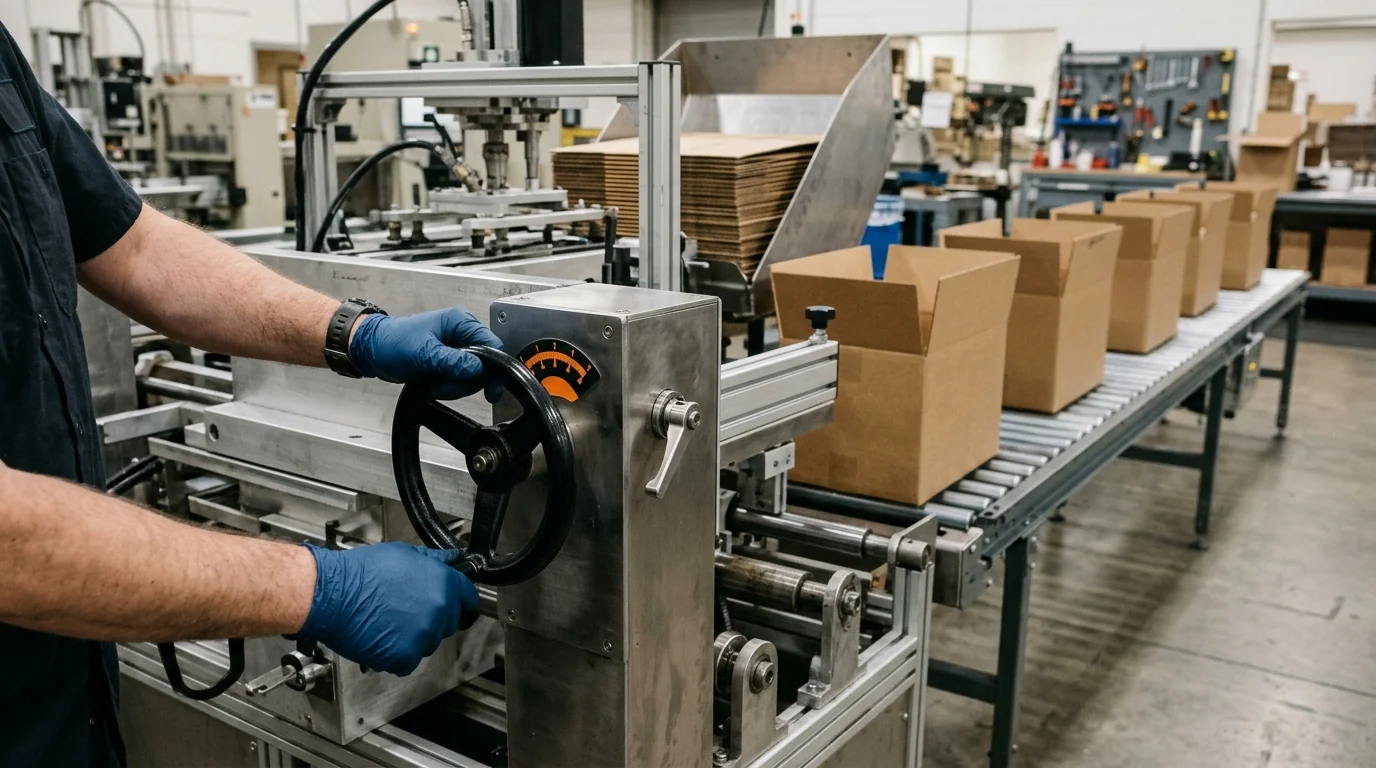
Conversely, hot-melt adhesive unlocks the highest erector speeds of 40 to 50 cases per minute on the A-B-C 400HS, A-B-C 450, Wayne WLRV-CE, and Pearson CE50, and up to 75 cpm on the Wayne VCE, while strengthening weak-walled or recycled boxes when paired with internal compression mandrels and controlled glue patterns. Across both sealing types, fast changeover relies on mechanical repeatability rather than manual trial and error: Pearson pairs scales, pointers, quick-release handles, and HMI graphical guides for changeovers under 8 to 10 minutes; Wayne Automation uses hand wheels with counters plus optional recipe-driven HMI one-touch changeovers; Wexxar WF30 executes 7-minute tool-less size changes with WISE HMI tuning; and Lantech reports cutting average changeover from 20–30 minutes on basic frames down to under 5 minutes under its Total Control System.
| Selection dimension | Pressure-sensitive tape bottom seal | Hot-melt adhesive bottom seal |
|---|---|---|
| Speed envelope | 8–35 cpm across compact and mid-speed models (Lantech C300/C400, Combi 2-EZ SB/HS, Pearson CE35, A-B-C 400 Tape) | 15–75 cpm including high-speed continuous and vertical-discharge builds (A-B-C 450, Pearson CE50, Wayne WLRV-CE & VCE) |
| Base electrical draw (Pearson CE35, 460 VAC) | 7.4 Amps base FLA | 18.3 Amps base FLA (33 Amps on servo CE50) |
| Compressed air draw (Pearson CE35, 80 PSI) | 0.844 SCF/cycle | 1.598 SCF/cycle (0.742 SCF/cycle on servo CE50) |
| Trained changeover estimate (Pearson CE35) | 7 minutes with scales, pointers, and quick-release handles | 9 minutes (10 minutes on servo CE50) |
| Box style and recycled board support | Standard RSC, HSC, and FOL runs with clean center seam closure | RSC, HSC, CSSC, Tablock, and weak-walled recycled cases via compression mandrels |
| OCC repulping behavior | Plastic or reinforcement tapes separating cleanly in recycling avoid problematic stickies (FEFCO guidance) | EPRC-screenable grades require ≥68 °C (154 °F) softening point and ≥120 µm (4.7 mil) non-reactive or ≥60 µm (2.4 mil) reactive thickness; lower-softening glues generate tacky OCC stickies |
Which Corrugated Blank Tolerances Should Buyers Verify Before Commissioning?
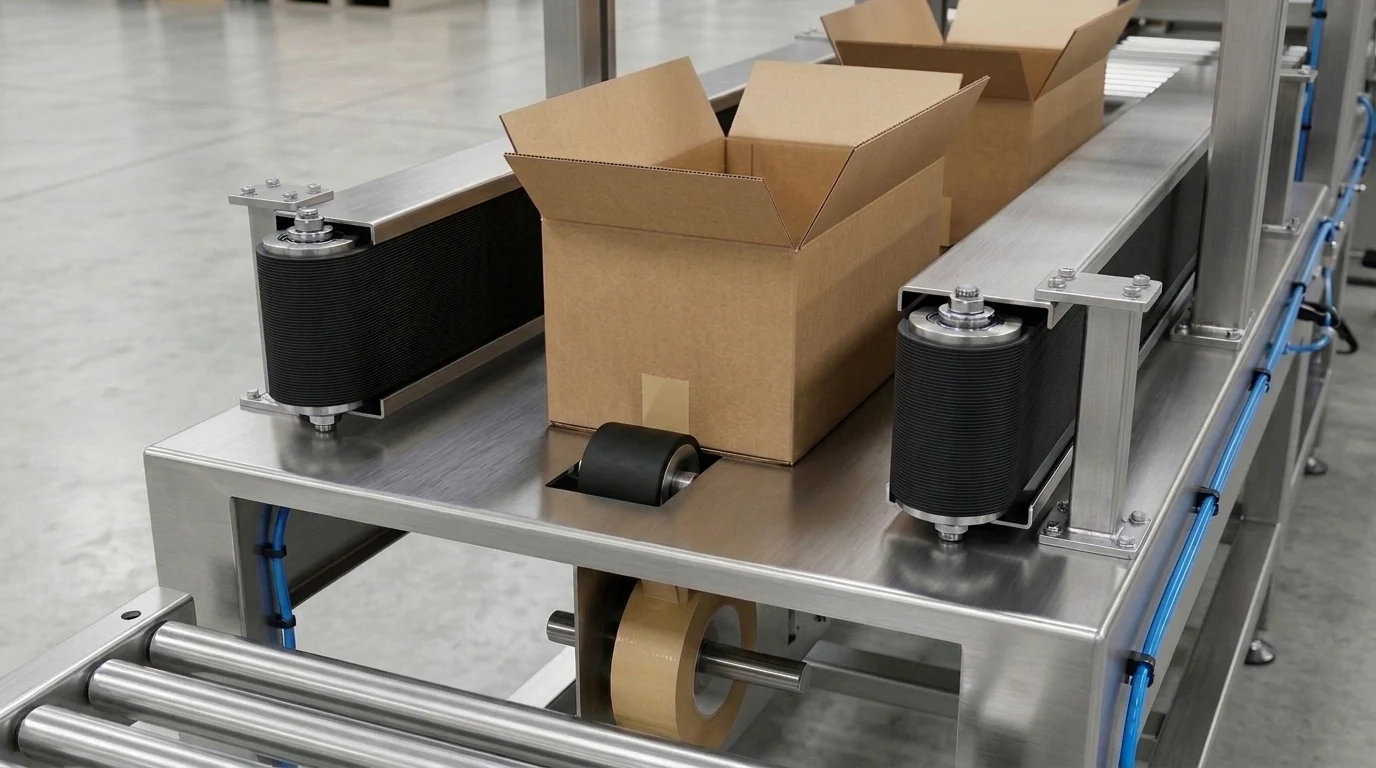
Buyers prevent forming jams by conditioning test blanks under ASTM D4332-22 before machine trials, controlling warehouse humidity to avoid moisture-driven strength loss, and running actual production recycled-fiber blanks through the supplier’s forming frame.
Humidity Conditioning, Moisture Window, and Flute Directionality
Under ASTM D4332-22, cellulosic packaging materials undergo physical property changes whenever temperature and relative humidity vary, so packages should be placed and kept in a specified atmosphere before reproducible performance testing—with Practice D685 specified when quantifying box compression strength at standard atmosphere conditions. In corrugated board moisture testing conditioned at standard 23 °C (73.4 °F) and 50% RH, equilibrium board moisture measures 6.77% for B flute, 6.94% for C flute, 7.14% for E flute, 7.08% for EB double-wall, and 6.92% for BC double-wall. Because elevated humidity opens inter-fiber bonds, published corrugated moisture research cites roughly a 10% loss in mechanical strength for every 1% increase in moisture content, while compression testing of boxes conditioned under ASTM D4332 confirms that recycled-fiber grades are more sensitive to moisture than virgin kraftliner and semi-chemical fluting.
Corrugated board is also anisotropic: under corrugated fluting and orthotropy testing, mechanical strength depends on paper fiber alignment along the machine direction (MD, perpendicular to fluting) versus the cross direction (CD, parallel to fluting), with tensile strength, bending stiffness, and compressive strength significantly higher in MD than in CD. Standard fluting profiles span A (tallest flute height), B, C, E, and F (lowest flute height). Note that shipping-case erection operates on knock-down corrugated fiberboard blanks rather than consumer folding cartons; for primary retail folding-box handoff, compare horizontal vs. vertical cartoner infeed and flap handoff.
Recycled Corrugated Degradation and Pre-Shipment Blank Trials
Sustainability targets have pushed recycled fiber shares steadily upward across shipping cartons. Combi Packaging Systems cautions that the physical properties of corrugated board degrade through the recycling process, reducing the consistency and repeatability that automated opening systems prefer. To keep uptime high on weaker or warped stock, verify how the candidate erector compensates mechanically:
- Compression mandrels and controlled gluing: Wayne Automation handles weak-walled or recycled corrugated boxes using compression mandrels and controlled glue systems to preserve structural stability for downstream handling.
- Forgiving heavy-duty frames: A-B-C Packaging builds mechanical-drive erectors designed to tolerate less-than-perfect corrugated on demanding lines, while also offering oversized frames such as Model 440 accepting knock-down blanks up to 45″ L × 42″ W (erected maximum 26.75″ L × 22″ W × 24″ H).
- Positive vacuum and side-belt retention: Dual opposed vacuum opening (Pearson) or eight-cup hinged pickup with spring-loaded exit belts (Lantech) prevents score springback from twisting lighter recycled walls out of square.
- Right-hand and left-hand blank orientation: Combi’s 2-EZ series handles both left-hand (LH) and right-hand (RH) cases on the same unit, and Wayne’s WLRV-CE likewise runs both RH and LH RSC/HSC blanks without re-handing the line.
When Does a Fixed Case Erector Beat On-Demand Box Making?
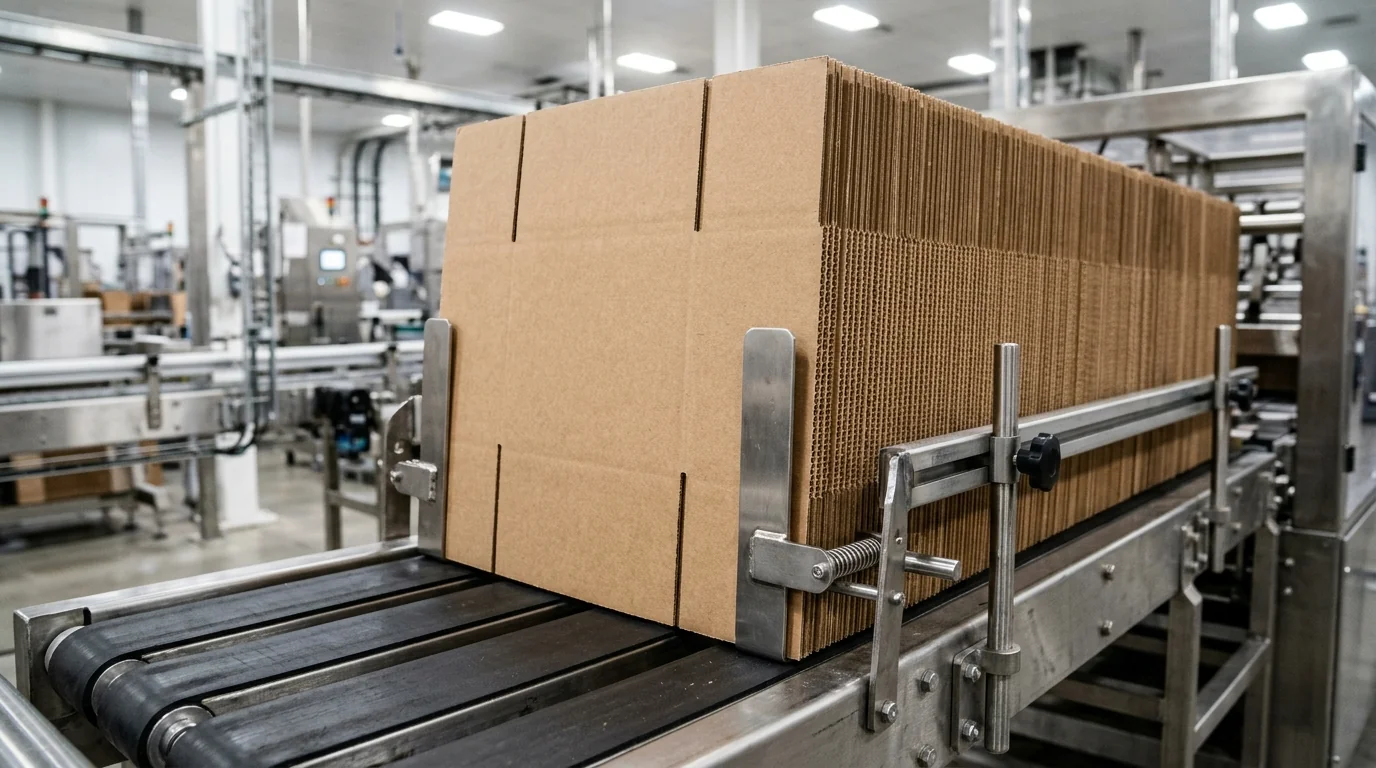
A fixed-footprint stock-box case erector outperforms an on-demand box-making machine whenever a plant runs recurring, high-volume SKU batches in standardized case footprints, whereas on-demand fanfold systems win on mixed-dimension e-commerce orders where stock boxes waste board and trailer cube.
Matching Erector Architecture to SKU Count and Order Variability
Packsize’s operational comparison outlines the clear boundary between the two categories. Fixed stock-box case erectors automate high-speed assembly of pre-made corrugated blanks in tandem with downstream fillers, sealers, and labelers, making them the standard choice for steady manufacturing runs. However, fixed erectors remain limited to pre-made stock sizes and require warehouse floor space to stockpile blank pallets; Packsize reports that stock boxes are 40% oversized on average and take up 33% more space on trucks.
On-demand automated packaging machines instead cut custom right-sized boxes for each order directly from continuous corrugated fanfold sheets, eliminating excess void fill and stock-box storage across highly variable product shapes. For plants caught in the middle—running two to eight recurring box sizes per shift without justifying full fanfold converting—multi-format case erectors bridge the gap cleanly:
- Dual-magazine case erectors: Combi offers a Dual Magazine configuration that erects two different case sizes without manual changeover.
- Multi-format random erectors: Lantech’s MFC1000 (up to 18 cases per minute) and MFC2000 (up to 16 cases per minute) transition seamlessly across varying case sizes with tape or hot-melt closing.
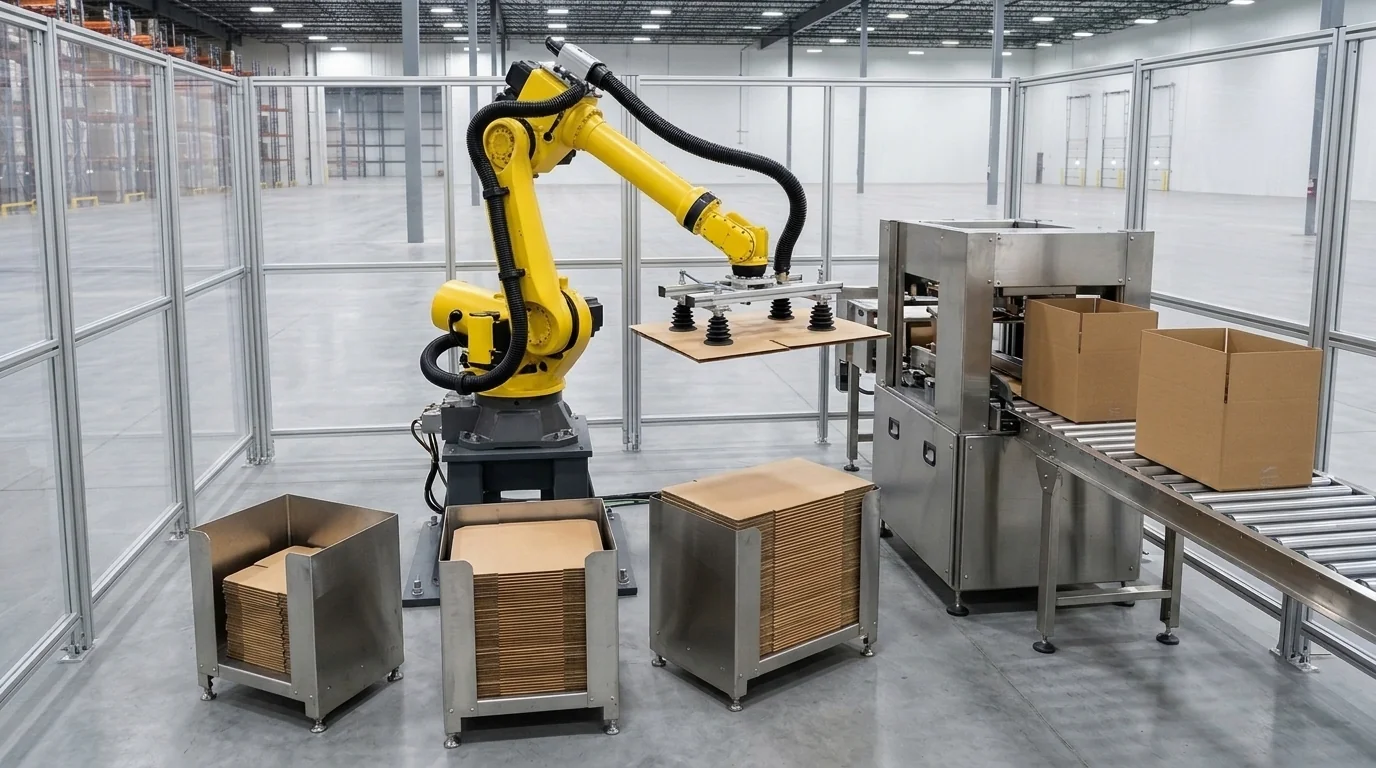
- Robotic random case erectors: Combi’s RCE Robotic Random Case Erector pairs a FANUC M-10iD/12 six-axis robot with multiple magazines, a bottom flap folder, and an integrated 3M tape head to erect up to eight different case sizes on demand.
| Architecture | Corrugated input format | SKU mix sweet spot | Throughput & changeover behavior | Warehouse & freight trade-off |
|---|---|---|---|---|
| Fixed stock-box case erector | Pre-made flat knock-down RSC, HSC, FOL, or CSSC blanks | High-volume manufacturing runs with standardized case sizes | 8 to 75 cpm across models; tool-less changeover from under 5 to 10 min (or HMI recipe) | Requires pallet staging for pre-made blanks; stock boxes average 40% oversized and use 33% more truck space when product sizes vary widely |
| Multi-magazine or robotic random erector | Two to eight pre-made blank magazines staged around one forming cell | Mid-volume plants and distribution lines with two to eight active box footprints | 16–18 cpm on multi-format frames (Lantech MFC1000/MFC2000) or up to eight sizes on demand (Combi RCE with FANUC M-10iD/12) | Eliminates changeover stops across core box sizes while preserving pre-made blank supply chains |
| On-demand right-sized box machine | Continuous corrugated fanfold sheets cut and creased per order | High-variability e-commerce and custom-shape order fulfillment | Produces custom-fitted boxes per order while cutting, creasing, erecting, and sealing | Eliminates stock-box stockpiling, reduces void fill, and cuts dimensional shipping volume |
How Do Engineers Integrate Outfeed Alignment, Guarding, and Lockout Controls?
Reliable line integration depends on matching upright discharge alignment and PLC handshakes to downstream packing stations, anchoring and guarding moving points of operation under OSHA 1910.212, and enforcing full energy isolation under OSHA 1910.147 before clearing jams or adjusting guides.
Upright Discharge Alignment, PLC Handshakes, and Safety Circuits
Integrating a carton erector into an active packaging automation cell starts at the discharge transfer. Wayne Automation connects its erectors to upstream and downstream machinery through customizable I/O setups, precise case discharge alignment, and vertical case discharge options (on models such as the WMCE and VCE) that keep cases upright and stable without tipping mechanisms. Pearson likewise notes that vertically formed cases avoid tip-up modules to save floor space, while horizontal forming and sealing provide tight case control at higher speeds; both CE35 and CE50 standardize on Allen-Bradley CompactLogix PLCs, PackML compliance, PanelView color HMIs, CAT-3 dual-channel safety circuits that preserve safety function after a single component failure, and non-contact guard door interlocks that prevent keyed-switch misalignment.
Machine Guarding, Floor Anchoring, and Lockout/Tagout Boundaries
Federal workplace rules set binding mechanical and procedural boundaries for every automatic case erector installation:
- Point-of-operation and nip-point guarding: Under OSHA 1910.212 paragraph (a)(1) and (a)(2), one or more methods of machine guarding—such as barrier guards or electronic safety devices—must be affixed to the machine where possible to protect operators and nearby staff from the point of operation, ingoing nip points, rotating parts, flying chips, and sparks without introducing new hazards.
- Fixed machinery anchoring: Under OSHA 1910.212 paragraph (b), machines designed for a fixed location must be securely anchored to prevent walking or moving during high-cycle forming strokes.
- Energy isolation during unjamming and changeover: Under OSHA 1910.147, servicing and maintenance explicitly includes setting up, adjusting, unjamming, and tool changes whenever guards are bypassed or employees place body parts into a danger zone. Because paragraph (b) defines energy sources to cover electrical, mechanical, hydraulic, pneumatic, chemical, and thermal energy, authorized technicians must isolate main electrical disconnects, dump stored pneumatic vacuum/cylinder air, and control thermal hazards on hot-melt tanks—aligned with a plant lockout/tagout procedure checklist for packaging machines.
Pre-Commissioning Carton Erector Intake Worksheet
Record the following material, layout, and safety inputs before running a factory acceptance test with actual production corrugated blanks.
| Qualification area | Line data to capture before vendor trial | Acceptance check during blank run |
|---|---|---|
| Case style & blank geometry | FEFCO / ASTM D5118 code (RSC 0201, FOL 0203, CSSC 0204, HSCC 0200), LH/RH print hand, and min/max erected L × W × H | Confirm every active box format fits within standard frame range without custom extensions |
| Board grade & moisture control | Flute profile, recycled fiber content, warehouse temperature/RH conditioning, and score-line depth | Run conditioned production blanks to verify clean score folding, zero double picks, and crisp 90° corners |
| Drive & bottom closure utilities | Peak line cpm, available 120V/240V/460V electrical service, plant 80 PSI compressed air capacity, and OCC recycling requirements | Verify tape vs. hot-melt seal integrity under distribution test criteria and confirm air/FLA headroom |
| Changeover & outfeed handshake | Daily changeover frequency, target changeover minutes, downstream conveyor elevation, and upstream/downstream PLC I/O interlocks | Time a full tool-less changeover using scales, dials, or HMI recipes and confirm jam-free upright discharge |
| Guarding & LOTO readiness | Floor anchoring layout, interlocked polycarbonate doors, CAT-3 circuit verification, and lockable electrical/pneumatic isolation points | Validate OSHA 1910.212 guarding and written 1910.147 unjamming/setup energy-control steps |
Sources
- ASTM International — ASTM D5118/D5118M-22 Standard Practice for Fabrication of Fiberboard Shipping Boxes
- ASTM International — ASTM D1974/D1974M-22 Standard Practice for Methods of Closing, Sealing, and Reinforcing Fiberboard Boxes
- ASTM International — ASTM D4332-22 Standard Practice for Conditioning Containers, Packages, or Packaging Components for Testing
- FEFCO — International Fibreboard Case Code (12th Edition)
- FEFCO — Factsheet on Recyclability: Corrugated Cardboard Packaging (2025)
- OSHA — 1910.212 General Requirements for All Machines
- OSHA — 1910.147 The Control of Hazardous Energy (Lockout/Tagout)
- Polymers (NIH/PMC) — Chemical Characterization and Enzymatic Control of Stickies in Kraft Paper Production
- Materials (NIH/PMC) — Compressive Strength of Corrugated Paperboard Packages with Low and High Cutout Rates
- Materials (NIH/PMC) — Investigating the Effect of Perforations on the Load-Bearing Capacity of Cardboard Packaging
- Materials (NIH/PMC) — Estimation of the Edge Crush Resistance of Corrugated Board Using Artificial Intelligence
- Scientific Reports (NIH/PMC) — Preliminary Studies on Recycling Cardboard Packaging into Building Products
- A-B-C Packaging Machine Corporation — Case Erectors & Sealers
- Wayne Automation — Automatic Case Erectors
- Pearson Packaging Systems / Professional Packaging Systems (Pro Pac) — CE35 and CE50 Case Erectors
- Combi Packaging Systems — 2-EZ Series, Dual Magazine, and RCE Robotic Random Case Erectors
- Lantech — Total Control System and Case Erectors Lineup
- Packsize — Case Erector vs. Automated Packaging System Comparison
- Frain Industries — Wexxar WF30 LTR Case Former Overview