
A course-completion record does not show whether an operator can recognize an abnormal pack on the assigned machine. Build training around observable tasks, the current equipment procedure and a clear boundary between normal operation and authorized maintenance.

Start with the machine, product and permission boundary
Name the equipment, format and material covered by the training. Gather the current manual, approved operating procedure and quality criteria. Identify the person who can coach the task and the person who can authorize release for independent operation.
Foundational learning still helps. PMMI’s fundamentals course covers packaging-machinery families and production-line concepts. It can support vocabulary and context; the public course description does not establish competence on a particular installed machine.
Before practice, agree which actions the learner may take and when they must stop and call for help. Keep access to guarded areas, energy isolation and maintenance work within the site’s authorization system. Do not treat a normal-operation signoff as permission for servicing.
Assess a demonstrated task
Ask the learner to explain what they expect to see, perform the permitted task under supervision and identify a condition that requires escalation. An assessor should record the observation, not simply tick that a topic was mentioned.
| Learning task | Evidence of understanding | Record at assessment |
|---|---|---|
| Identify the job | Matches product, material and approved recipe to the work order | Machine, format and procedure revision |
| Recognize acceptable output | Explains the local pack-quality criteria using approved samples | Criteria and sample references |
| Follow a normal sequence | Demonstrates the approved task without improvised intervention | Observation and any coaching required |
| Respond to an abnormal condition | States when to stop and who to notify under site rules | Scenario, response and remaining gap |
| Hand over the shift | Communicates settings status, holds and unresolved faults | Completed handoff example |
| Maintain the role boundary | Identifies work requiring further authorization | Permission limits and escalation contact role |
Assessment should happen in a language and format the learner understands. If performance depends on continual prompting, record further supervised practice rather than signing off the task.
Separate operator awareness from maintenance authorization
For US workplaces within its scope, OSHA’s hazardous-energy standard distinguishes affected-employee instruction from authorized-employee training. It specifies training and retraining responsibilities in section 1910.147(c)(7). Those distinctions help explain why one generic machine course cannot authorize every task.
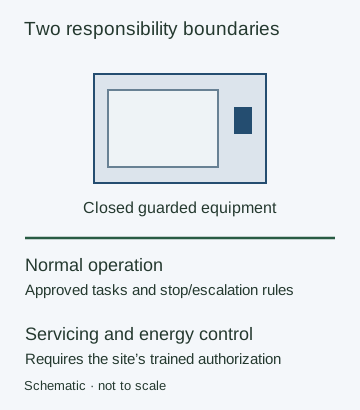
The diagram describes the responsibility boundary. It does not depict an isolation sequence or replace a site-specific energy-control procedure. The employer must determine applicable requirements and the training needed for the actual hazards.
Keep the signoff narrow enough to remain useful
A training record should identify the learner, assessor, date, equipment, procedure revision and tasks observed. Record whether the learner may work independently, requires supervision or needs additional instruction. Include conditions that were not covered, such as another format or a different material.
Link reassessment to changes. OSHA specifies retraining triggers for affected and authorized employees when relevant assignments, equipment, processes or procedures change, and when deficiencies require it. Beyond those requirements, review your task assessment whenever a change makes the previous observation a poor description of the job.
Use a short coaching loop: explain the missed decision, demonstrate within the approved procedure, then observe the learner again. Keep the original gap and follow-up outcome visible. Repeating the same presentation without checking the task gives little evidence of progress.
The maintenance-handoff guide provides the record for faults an operator reports. Return to technical workforce to plan how equipment changes affect learning.
Methods and limits
This is an original coaching framework based on the cited course scope and public OSHA text. It is not a certification, an OEM course or permission to operate equipment. Use the actual manual and qualified site leadership to determine tasks and authorization. Checked October 2026.