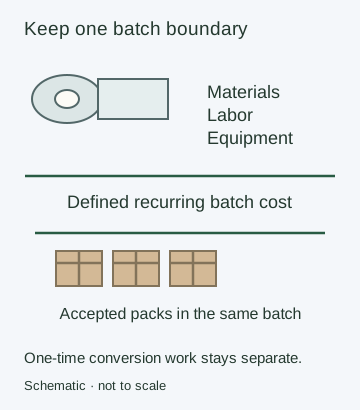
A packaging cost comparison fails when the two alternatives count different work or divide by different output. Define one batch boundary, reconcile the costs within it and report accepted packs on that same boundary.
State which decision the model supports
A production-cost model can compare material or operating changes. A cash-investment model asks which payments change because of a project. An accounting report may allocate costs that continue even if the project proceeds. Choose the view and label it; otherwise an allocated saving can be mistaken for cash released.
Start with a batch or a representative period: product, pack format, quantity, shift conditions and quality acceptance. Include setup and first-piece approval if they are part of the job being compared. A steady-running estimate will not represent a short batch that spends much of its time changing over.
The NIST Manufacturing Cost Guide primer describes costs grouped through standardized industry and occupation categories using static source data. It offers background for organizing costs, rather than plant-specific rates. The worksheet here needs your own records.
Assemble the batch record
Assign each resource to one place in the model. Record the source and whether it is measured, quoted or assumed. Keep rejected product visible; do not divide costs by nominal batch quantity if fewer packs are accepted.
| Cost group | Quantity or basis | Evidence | Double-count check |
|---|---|---|---|
| Materials issued net of returns | Whole-pack bill of materials and actual consumption | Issue/return records and commercial price | Is process scrap already included in usage? |
| Direct labor | Relevant preparation, run and closeout hours | Time record and approved labor-cost basis | Are these hours also in the machine rate? |
| Equipment-related costs | Stated use or allocation basis | Approved rate composition or actual expense | Does the rate already include utilities or maintenance? |
| Quality and rework | Incremental work and losses on this boundary | Disposition and rework records | Is the same loss already in materials and labor? |
| Other overhead | Declared allocation method | Accounting policy | Is this a cash change or only an allocation? |
| Accepted output | Packs meeting the batch acceptance rule | Released count | Are rejects or incomplete packs included? |
Do not add a general “scrap cost” after charging all issued material and all worked hours unless it represents a separate loss. A reconciliation note is more useful than an unexplained adjustment.
Copyable baseline-versus-alternative worksheet
Use one currency and one comparison period. Copy the blank tables, then enter the quantity, rate and extended cost for each resource. Repeat a material or labor row when it contains unlike units or rates. “B” denotes the baseline and “A” the alternative; the letters are record labels, not supplied values.
| Comparison definition | Entry |
|---|---|
| Decision view: accounting cost or incremental cash | ______ |
| Product / format and batch or period | ______ |
| Currency; quantity units; time units | ______ |
| Acceptance rule and shared boundary | ______ |
| Equipment-rate inclusions, including any labor | ______ |
| Evidence / assumption version and preparation date | ______ |
| Cost row | B quantity | B rate | B extended cost | A quantity | A rate | A extended cost |
|---|---|---|---|---|---|---|
| M: materials, net of returns | ______ | ______ | q × r = ______ | ______ | ______ | q × r = ______ |
| L: direct labor not already included | ______ hours | ______ / hour | h × r = ______ | ______ hours | ______ / hour | h × r = ______ |
| E: equipment on declared rate basis | ______ hours | ______ / hour | h × r = ______ | ______ hours | ______ / hour | h × r = ______ |
| Q: additional quality / rework resource | ______ | ______ | q × r = ______ | ______ | ______ | q × r = ______ |
| O: other overhead on stated basis | ______ | ______ | q × r = ______ | ______ | ______ | q × r = ______ |
| Result / separate project item | Baseline | Alternative |
|---|---|---|
| Recurring total T = M + L + E + Q + O | T_B = ______ | T_A = ______ |
| Accepted output N on the same boundary | N_B = ______ packs | N_A = ______ packs |
| Recurring cost per accepted pack C = T ÷ N | C_B = ______ | C_A = ______ |
| Difference per accepted pack | Reference | C_A − C_B = ______ |
| One-time conversion work, outside T | ______ | ______ |
| Forecast quantity and period, if allocating one-time work | ______ | ______ |
| Unresolved input / source missing | Effect on comparison | Evidence or next action | Owner and review date |
|---|---|---|---|
| ______ | ______ | ______ | ______ |
Sum repeated rows within each cost letter before calculating T. Leave unknown inputs blank. Enter zero only when the chosen boundary and evidence justify it. If an equipment rate includes the same direct-labor hours, identify that inclusion in row E and exclude that duplicate charge from row L. Use only additional rework resources in Q; material and labor already counted in M or L stay there. Apply the cost-per-pack formula only when accepted output N is greater than zero. A zero-output batch has no finite cost per accepted pack and needs investigation.
Compare recurring cost and one-time work separately
Calculate the defined recurring batch cost divided by accepted output. Place tooling, integration, training and qualification beside that result as one-time work. If you allocate them across forecast output, state the forecast and period.
A project may free operator time without reducing payroll. Record the released time and the work it could support. Count a cash saving only where the payment changes under the stated scenario. Keep additional capacity separate from revenue until demand and the next process can use it.
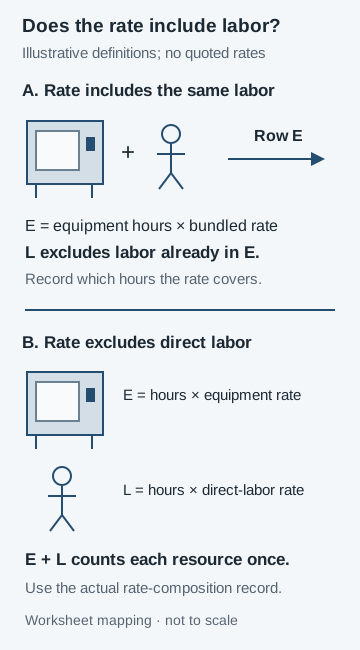
The two rate definitions illustrate a bookkeeping choice, with no quoted rates or assumed savings. Match each definition to its supporting rate composition before filling the worksheet.
Test the assumptions that drive the result
Change the batch-size assumption, the accepted-output assumption and any uncertain changeover time in separate scenarios. Do not bundle every optimistic assumption into the proposed alternative. Include a documented downside case where qualification takes longer or demand is lower.
A useful comparison record ends with the unresolved input most likely to reverse the choice and the action that could resolve it. A short trial may settle usage; a supplier’s scope may settle tooling; production records may reveal that the assumed labor hours belonged to a different format.
Keep the denominator consistent with the capacity record. If the project starts with a suspected bottleneck, use the automation observation sheet first. Return to manufacturing automation for the full decision sequence.
Methods and limits
This is an original decision worksheet, not an accounting policy, quoted price or investment forecast. No plant rates or assumed savings are supplied. The old NIST software address now leads to a supply-chain statistics tool; use the linked historical primer only within its stated scope. Checked October 2026.